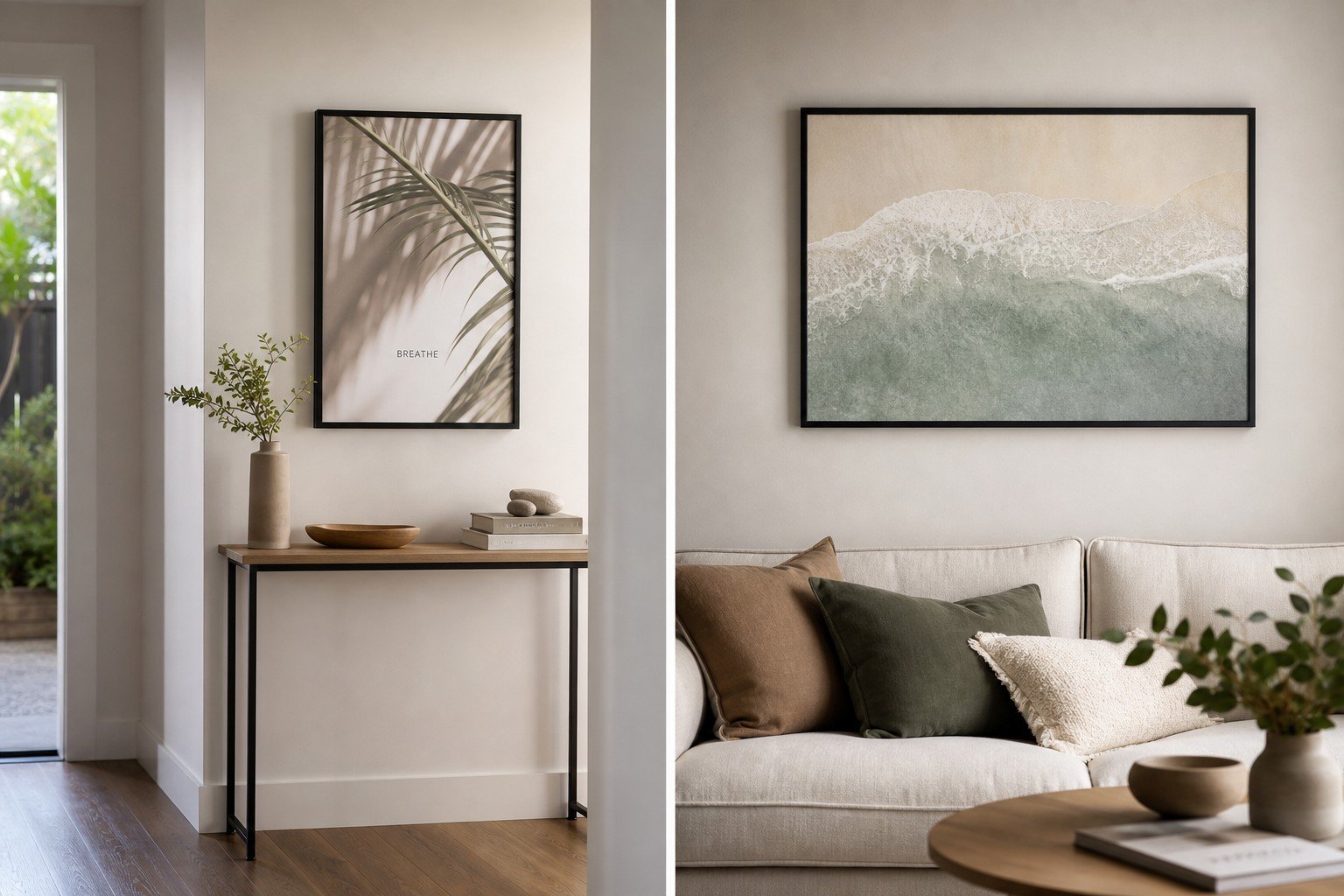
A large print can change a room more than almost any other single purchase. One well-chosen poster above a sofa, desk or bed gives the space a focal point, and it costs a fraction of a new piece of furniture. The tricky part usually isn’t choosing the artwork. It’s working out which frame it actually needs.
Two sizes come up again and again when people shop for large wall art in the UK: 50 x 70 cm and A1. On paper they look similar, and many people assume they’re interchangeable. They aren’t, and knowing why will save you a return, a trimmed poster or a print that buckles behind the glazing.
Why these two sizes are everywhere
The size of your print usually depends on where it came from.
Many independent artists and online art shops, particularly those based in Europe, sell their prints at 50 x 70 cm. It has become something of a default for illustrations, botanical prints, photography and minimalist typography posters.
A-sizes come from the international paper standard that UK printers, universities and offices use. If you’ve had something printed locally, such as an architectural drawing, a map, a design project or a large photograph, there’s a good chance it came back as A1, A2 or A3.
So the first step is simple: check how your print is labelled, then measure it anyway.
The numbers side by side
| 50 x 70 cm | A1 | |
| Size in cm | 50 x 70 | 59.4 x 84.1 |
| Size in inches (approx.) | 19.7 x 27.6 | 23.4 x 33.1 |
| Shape (ratio) | 5:7 | 1:1.414 |
| Common sources | Art prints, online poster shops | UK print shops, plans, maps, student work |
A1 is noticeably larger, nearly 10 cm wider and 14 cm taller. It also has a different shape. A1 is slightly longer and narrower in proportion, which is why an A1 print will never sit neatly in a 50 x 70 frame, even with trimming, without losing part of the image.
Shape matters more than size
When people get a frame wrong, it’s usually the proportions, not the dimensions, that catch them out. Every A-size shares the same ratio, so an A3 or A2 print scales up perfectly to A1. A 50 x 70 print follows a different ratio, closer to a classic art-print shape.
In practice, this means:
- An A-size print belongs in an A-size frame or a larger frame with a mount.
- A 50 x 70 print belongs in a 50 x 70 frame or a larger frame with a mount.
- Forcing one into the other leaves uneven gaps or cropped edges.
When a 50×70 frame is the right choice
If your print measures 50 x 70 cm, the answer is easy: buy the matching size. Frame sizes refer to the artwork the frame holds, not its outer edge, so a 50 x 70 print drops straight in.
This size also works well in rooms where an A1 piece would feel overpowering, such as a bedroom wall beside a wardrobe, a home office or a narrow hallway. It’s big enough to make a statement but still leaves breathing room around it.
A 50×70 frame is also surprisingly versatile with a mount. An A2 poster (42 x 59.4 cm) fits comfortably inside one with a card border, which gives it a cleaner, more gallery-like finish than a frame that hugs the edges.
When an A1 frame makes more sense
If your print came from a UK print shop or is a scaled-up version of an A3 or A2 design, you’ll want an A1 frame. Typical examples include:
- Architectural and interior design drawings
- Large-format photography printed locally
- Vintage-style maps and city plans
- Graduation projects and portfolio pieces worth keeping on display
A1 is the natural choice for a large, open wall, such as a living room with high ceilings, a long stairwell or the space above a wide sofa. An A1 frame cut to the exact A-series dimensions keeps the borders even, which matters more on a print this size because any misalignment becomes obvious from across the room.
Using a mount to bridge the gap
A mount is the card border between the print and the glazing. Beyond looking good, it solves a practical problem: it lets a smaller print sit properly inside a larger frame.
A few reliable combinations:
- A2 print in a 50 x 70 frame: the mount gives a balanced border on all sides.
- A2 print in an A1 frame: this gives a generous border with a more formal, museum-style look.
- Print sizes between standards: go up to the next frame size and use a mount rather than squeezing it into something too small.
Before you add a mount, check the frame’s depth. The glazing, mount, print and backing all need to fit inside the rebate without straining the clips.
Details people often overlook
The frame is bigger than the label. The moulding adds width on every side, so a 50 x 70 cm frame will take up more than 50 x 70 cm of wall. Measure your space with that in mind, especially above furniture.
Edges get covered. The lip that holds everything in place overlaps the print by a few millimetres. If your artwork has text or a signature right at the edge, a mount can help keep it visible.
Glazing affects weight and safety. On large frames, acrylic or plexiglass is lighter than glass and won’t shatter. That’s worth considering in children’s rooms, busy hallways and rented homes where you may not want heavy-duty fixings.
Hang it at eye level. A good starting point is to put the centre of the artwork around 145–155 cm from the floor. Above a sofa or headboard, leave a gap of roughly 15–25 cm so the piece feels connected to the furniture rather than floating.
Styling ideas by room
- Living room: One A1 print as the anchor works well on a large wall. For a gallery wall, use a 50 x 70 piece in the centre with smaller A3 and A4 frames around it.
- Bedroom: A 50 x 70 frame above the bed keeps the space calm and balanced. Soft white or natural oak frames suit lighter colour schemes.
- Home office: An A1 map, blueprint or typography poster adds character and gives you something better than a blank wall behind you on video calls.
- Hallway: Two 50 x 70 frames hung side by side create rhythm in a long, narrow space without crowding it.
As a rule of thumb, black frames suit bold graphic and film posters, white frames flatter colourful modern art, and wood finishes warm up botanical, travel and vintage prints.
A quick checklist before you buy
- Measure your print edge to edge with it lying flat.
- Check whether the size matches a centimetre standard (50 x 70) or an A-size (A1).
- Decide whether you want a mount and size the frame accordingly.
- Measure the wall, allowing for the frame’s outer dimensions.
- Choose glazing and colour based on the room and the artwork.
Final thoughts
The difference between a 50 x 70 frame and an A1 frame comes down to where your print came from and the shape it was designed in. Match the frame to the print’s measured size rather than guessing from the label, consider a mount when sizes don’t line up exactly, and plan for the frame’s full outer dimensions on the wall. Get those few details right, and a large print will look like a deliberate design choice rather than an afterthought.
Both links point to the matching product pages, use exact-match anchors once each, and sit in the body where they help the reader. If Eopis asks you to vary the anchors, “50 x 70 cm picture frame” and “A1 picture frame” are good natural alternatives.