AR glasses for immersive display crossed a meaningful threshold at CES 2026. The RayNeo Air 4 Pro AR glasses for gaming and entertainment launched at an MSRP of $299 — directly in portable-monitor territory — turning a once-niche comparison into a practical buying decision.
The Air 4 Pro brings HDR10 capability, Bang & Olufsen-tuned quad speakers, and a 76g build at a launch MSRP of $299 (check the official site for current pricing). Portable monitors bring consistent color accuracy on a physical panel, shared-screen visibility, and no face-worn hardware. Both solve the same problem differently — a larger screen away from home.
The Case for Portable Monitors
Portable monitors from brands like ASUS, LG, and Lepow typically weigh 600–900g and deliver reliable IPS panel color output within the sRGB range. For color-critical tasks — photo retouching, design reviews, or video grading — that consistency, combined with easier integration into ICC-profiled workflows, is currently difficult to match on AR immersive display glasses.
Shared-screen visibility is another genuine advantage. A portable monitor lets everyone in the room see the same image — useful for client presentations, peer reviews, or co-watching with a travel companion. Software compatibility is also simpler: portable monitors behave as standard displays without device-specific HDR protocol requirements or compatibility caveats.
Where the Two Categories Actually Differ
The core difference is not screen size — it is form factor and setup friction. A portable monitor is still a box you carry, unfold, and position on a surface. AR display glasses collapse that setup into 76 grams on your face, with a virtual screen that needs no table, stand, or alignment.
The Immersive Display Advantage
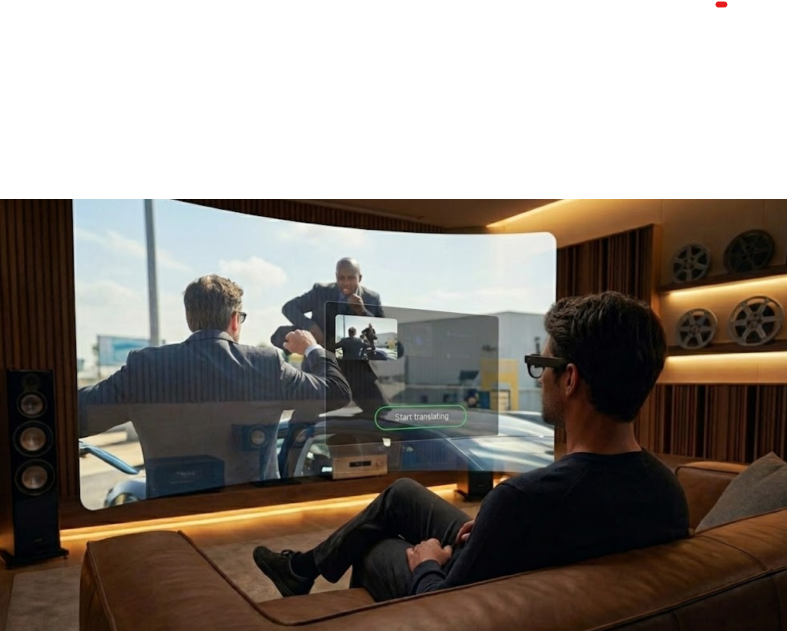
This is where AR glasses for immersive display reframe the problem. The image is projected directly into your eyes via micro-OLED panels, creating a private viewing experience with no glare from overhead lighting, no awkward screen angle to find, and no sightline available to anyone sitting beside you.
The Scale Problem No Portable Monitor Solves
A 15-inch portable monitor looks like a 15-inch screen regardless of placement. The Air 4 Pro creates a virtual screen experience equivalent to 201 inches at approximately 6 meters viewing distance, using dual 0.6-inch micro-OLED panels at 1920×1080 per eye. That is a different category of perceived scale — one that physical portable displays, constrained by panel size and carry weight, are not designed to approach.
The Screen-Everywhere Scenario
Whether in a cramped economy seat, a hotel room with limited desk space, or on public transit, AR display glasses deliver a consistent screen regardless of environment. The virtual image stays aligned to your line of sight — no surface required, no re-angling when someone sits beside you.
RayNeo Air 4 Pro: Technical Breakdown
RayNeo operates its own optical manufacturing facilities — a distinction that lets the company control component quality without third-party lens suppliers. Three engineered advantages in the Air 4 Pro make it competitive among AR glasses for gaming and media at this price range.
HDR10 and the Pixelworks Vision 4000 Chip
The Air 4 Pro is the world’s first AR glasses to support HDR10 display output. The Pixelworks-customized Vision 4000 chip handles real-time SDR-to-HDR conversion and AI-powered 2D-to-3D processing, making richer shadow detail and vivid highlights available on any content — not just natively HDR-encoded video. Peak brightness reaches 1,200 nits with a 200,000:1 contrast ratio.
Display Panel and Eye Protection
The dual micro-OLED panels run at 120Hz with 145% sRGB and 98% DCI-P3 color coverage. Eye protection comes through 3840Hz PWM dimming — high-frequency operation that significantly reduces flicker, making extended viewing less fatiguing. Three image quality modes (Standard, Movie, Eye Protection) and eight brightness levels give users direct control over their visual environment.
Weight, Fit, and Device Compatibility
The Air 4 Pro weighs 76g, with a 46.7%:53.3% weight ratio that keeps pressure off the nose bridge during extended use. Nine temple-arm levels accommodate most head shapes. USB-C DisplayPort carries the signal; RayNeo notes that HDR10 performance depends on the source device, cable, system version, and content — so actual results vary by setup. Devices with confirmed HDR output compatibility include:
- iPhone 15 and above (excluding iPhone 16e) and Macs
- Windows PCs with USB-C DisplayPort HDR output capability
- Nintendo Switch 2 (requires JoyDock); PS5 (requires an HDMI-to-USB-C adapter)
Many Android phones support video output, but whether the full HDR10 pipeline is achieved depends on the specific model and link conditions — check RayNeo’s compatibility page for your device before purchasing.
Side-by-Side Comparison
The table below shows how AR glasses for immersive display compare to a representative 15–17-inch portable monitor. Virtual screen size is an optical equivalence measure — RayNeo rates the Air 4 Pro at 201 inches at approximately 6 meters viewing distance, not a physical panel dimension.
| Spec | RayNeo Air 4 Pro | Portable Monitor (mid-range) |
| Screen | 201-inch virtual (~6m distance) | 15–17-inch physical |
| Weight | 76g | 600–900g |
| HDR | HDR10 (industry first for AR glasses) | Varies by model |
| Refresh Rate | 60Hz / 120Hz | 60Hz standard |
| Audio | 4-speaker B&O system | None or built-in mono |
| Privacy | Single-viewer | Visible to bystanders |
| Setup | Plug via USB-C | Stand or flat surface needed |
| Price | From $299 MSRP (check site for current) | $150–$400 |
Use Cases That Favor the Air 4 Pro
The Air 4 Pro makes its strongest case in three specific contexts: gaming with a handheld console, extended travel where portability determines what you carry, and solo entertainment in shared spaces where a private screen matters. In all three, a portable monitor introduces friction that AR glasses eliminate.

When Your Console Becomes a Cinema
When paired with a Nintendo Switch 2 (via JoyDock) or PS5 (via HDMI-to-USB-C adapter), the RayNeo Air 4 Pro AR glasses for gaming output a large-format HDR10 virtual display at 120Hz. The Vision 4000 chip adds AI 3D conversion to 2D game titles. Four B&O-tuned speakers handle surround audio without headphones — a combination that portable monitors are not designed to deliver in this form factor.
Long-Haul Travel
On a plane or in a hotel room, the Air 4 Pro draws power from the connected device via USB-C and needs no surface. The whisper audio mode reduces sound leakage to nearby passengers — a level of acoustic privacy that portable monitors, as open-speaker devices, are not built to provide. Prescription lens inserts attach magnetically for users who wear corrective eyewear.
Solo Entertainment in Shared Spaces
Whether in a shared Airbnb, an office break room, or on public transit, the single-viewer nature of immersive AR display glasses gives you control over who sees your content. A portable monitor broadcasts to anyone within sightline — for users reviewing sensitive documents or watching films publicly, that distinction changes the device’s practical value.
Who Should Stick With a Portable Monitor
Color professionals and design teams on calibrated workflows should not switch yet. AR display glasses, including the Air 4 Pro, are engineered for entertainment and general productivity — DCI-P3 coverage is solid, but integrating them into ICC-profiled color workflows for precision work is not currently practical in the way a calibrated physical display supports.
Three situations where a portable monitor remains the stronger choice:
- Color-critical professional work requiring ICC display profiles and consistent calibration
- Shared viewing for client presentations, collaborative reviews, or co-watching
- Extended desk sessions where face-worn hardware adds unnecessary friction
The Bottom Line
For travelers, solo entertainers, and gamers wanting a large private screen without carrying extra hardware, the RayNeo Air 4 Pro makes a compelling case at its launch MSRP of $299 — check the official site for current pricing. The HDR10 display, 76g build, and B&O audio are genuinely differentiated features for AR glasses in this category. Color professionals and collaborative workers are better served by physical displays for now. If your primary use case is private entertainment, handheld gaming, or on-the-go productivity in the single-viewer sense, the Air 4 Pro is worth a close look.