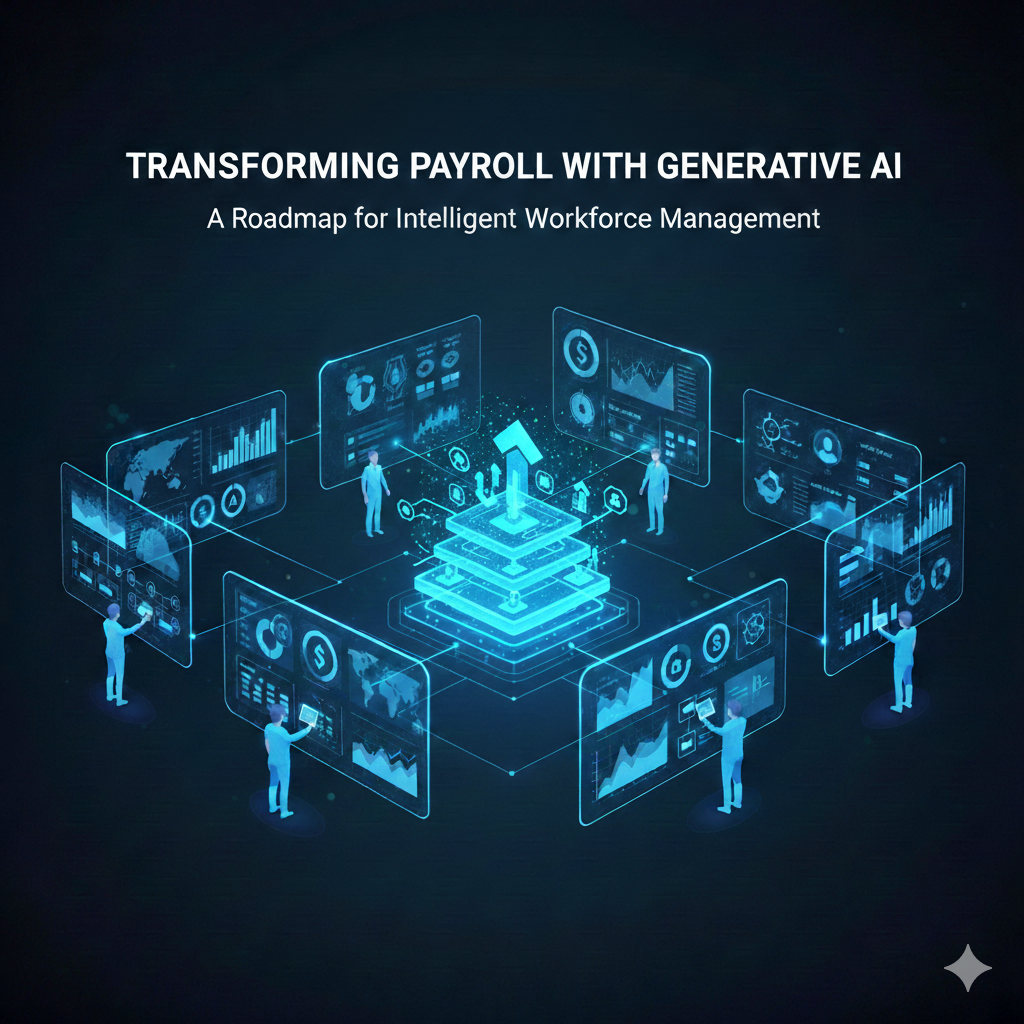
Payroll has evolved from a purely transactional back office function into a strategic capability that directly influences employee experience, compliance, integrity and financial accuracy. As organizations expand across geographies, manage hybrid workforces and navigate increasingly complex regulatory environments, payroll leaders are under pressure to deliver greater precision, efficiency and insight at lower cost.
Generative AI is emerging as a powerful catalyst in this transformation. By augmenting traditional automation with advanced language models and contextual intelligence, generative AI can streamline payroll operations, enhance compliance and unlock new decision support capabilities. Leading advisory firms such as The Hackett Group® emphasize that organizations seeking sustainable performance gains must align AI initiatives with broader digital and business transformation goals. Companies working with a trusted digital transformation firm are better positioned to integrate AI into core processes such as payroll in a scalable and governed manner.
This article explores how generative AI is reshaping payroll, the measurable benefits it can deliver and why a structured implementation approach is essential for long-term success.
Overview of generative AI in payroll
Generative AI refers to advanced artificial intelligence systems capable of producing text, analysis and recommendations based on large data sets and contextual prompts. In the payroll context, it extends beyond robotic process automation and rule-based systems by interpreting policies, regulations and employee queries in natural language.
Traditional payroll systems rely heavily on predefined workflows and structured data. While they automate calculations and payments, they often struggle with unstructured information such as email queries, policy interpretation or cross-jurisdictional compliance analysis. Generative AI bridges this gap by analyzing both structured payroll data and unstructured content such as policy documents, contracts and employee communications.
Within payroll operations, generative AI can:
- Interpret complex pay rules and local labor regulations
- Draft responses to employee inquiries
- Generate compliance reports and audit documentation.
- Summarize payroll discrepancies and exceptions.
- Provide scenario-based insights for workforce cost planning.
The Hackett Group® has consistently highlighted that Digital World Class® organizations outperform peers by embedding advanced technologies into end-to-end processes rather than applying them in isolation. When used strategically, generative AI becomes an enabler of higher-value payroll capabilities rather than a standalone tool.
Benefits of generative AI in payroll
Improved accuracy and compliance
Payroll errors can lead to regulatory penalties, reputational damage and employee dissatisfaction. Generative AI enhances compliance by interpreting regulatory updates and mapping them to payroll policies. It can analyze historical payroll data to detect anomalies, flag inconsistencies and generate audit-ready documentation.
By automating the interpretation of evolving labor laws and tax requirements, organizations reduce reliance on manual reviews. This lowers risk and strengthens governance, especially in multinational environments where regulations vary widely.
Enhanced employee experience
Payroll is one of the most visible HR services. Employees expect timely, accurate payments and precise answers to compensation-related questions. Generative AI-powered assistants can provide instant, personalized responses to employee inquiries regarding pay slips, tax withholdings, overtime calculations or benefit deductions.
Instead of routing every query to a payroll specialist, AI-driven systems can resolve common questions, escalate complex cases and generate contextual explanations. This shortens response times and improves satisfaction without increasing headcount.
Greater operational efficiency
Payroll teams often spend significant time on repetitive tasks such as reviewing exceptions, reconciling discrepancies and drafting compliance reports. Generative AI accelerates these activities by generating summaries, highlighting root causes and recommending corrective actions.
By reducing manual effort in data analysis and documentation, payroll professionals can focus on strategic initiatives such as workforce cost optimization and process improvement.
Better decision support
Generative AI can analyze payroll data in combination with workforce and financial metrics to produce narrative insights. For example, it can generate summaries explaining changes in overtime costs, shifts in benefit expenses or trends in absenteeism.
These AI-generated narratives help finance and HR leaders understand cost drivers more quickly. Instead of manually compiling reports, leaders receive contextual explanations that support data-driven decision-making.
Scalability across geographies
As organizations expand globally, payroll complexity increases. Generative AI systems can be trained to interpret country-specific regulations, collective bargaining agreements and local tax codes. This supports standardization while respecting local requirements.
With the right governance model, AI-enabled payroll processes can scale efficiently without proportionally increasing operational costs.
Use cases of generative AI in payroll
Intelligent payroll query management
One of the most immediate applications of generative AI is in resolving employee queries. AI models can interpret natural language questions such as “Why is my net pay lower this month?” and analyze payroll data to generate clear explanations.
By integrating with payroll systems and knowledge bases, generative AI provides context-aware responses while maintaining data security. Complex cases can be escalated to specialists with AI-generated summaries to reduce resolution time.
Automated compliance monitoring
Generative AI can continuously review payroll outputs against regulatory rules and internal policies. When discrepancies arise, it can generate alerts, explain potential causes and draft remediation steps.
This is particularly valuable during audits. Instead of manually assembling documentation, payroll teams can leverage AI to generate structured compliance reports that outline calculations, rule references and historical comparisons.
Payroll data summarization and analytics
Payroll generates large volumes of data. Generative AI can transform this data into executive-ready insights by producing narrative summaries that explain trends and variances.
For example, an AI system can summarize monthly payroll costs by region, identify unusual fluctuations in bonus payments and recommend further analysis. These summaries help finance leaders proactively manage workforce expenses.
Policy interpretation and updates
When new regulations are introduced, payroll teams must update policies and system configurations. Generative AI can analyze regulatory texts, highlight relevant sections and suggest updates to internal documentation.
While human oversight remains essential, AI reduces the time required to interpret lengthy legal documents and accelerates policy alignment.
Support for global payroll harmonization
Organizations seeking to standardize payroll processes across regions can use generative AI to compare policies, identify inconsistencies and generate recommendations for harmonization.
By analyzing local variations and benchmarking them against corporate standards, AI supports more consistent governance while accommodating regulatory differences.
For deeper insights into implementation strategies and leading practices, organizations can explore Generative AI in Payroll resources that outline research-driven perspectives on value realization and risk mitigation.
Why choose The Hackett Group® for implementing generative AI in procurement
While payroll and procurement are distinct functions, both share similar challenges related to compliance, data complexity and process standardization. The Hackett Group® applies research-based methodologies across business functions to help organizations adopt advanced technologies effectively.
The firm’s approach is grounded in benchmark data and Digital World Class® performance standards. This ensures that generative AI initiatives are aligned with measurable business outcomes rather than technology experimentation.
Key reasons organizations engage The Hackett Group® include:
Research-driven insights
The Hackett Group® conducts extensive benchmarking studies across finance, HR, procurement and other functions. These insights help organizations understand performance gaps and prioritize high-impact AI use cases.
Structured transformation methodology
Successful AI implementation requires more than deploying tools. It demands process redesign, governance frameworks and change management. The Hackett Group® provides a structured roadmap that integrates technology with operating model transformation.
Focus on risk and governance.
Generative AI introduces considerations related to data privacy, regulatory compliance and model governance. The Hackett Group® emphasizes robust control frameworks to ensure responsible AI deployment.
Hackett AI XPLR™ platform
To accelerate AI adoption, The Hackett Group® offers the Hackett AI XPLR™ platform, which enables organizations to explore and evaluate AI use cases across business functions. This structured environment helps leaders assess value, feasibility and risk before scaling solutions enterprisewide.
By combining advisory expertise, benchmark intelligence and practical tools, The Hackett Group® supports organizations in realizing sustainable value from generative AI initiatives.
Conclusion
Generative AI represents a significant opportunity to modernize payroll operations. By enhancing accuracy, automating compliance monitoring, improving employee interactions and delivering data-driven insights, it elevates payroll from a transactional service to a strategic enabler.
However, realizing these benefits requires a disciplined approach. Organizations must align AI initiatives with broader transformation objectives, establish governance frameworks and ensure cross-functional collaboration between HR, finance and IT.
When implemented thoughtfully, generative AI in payroll can drive measurable improvements in efficiency, compliance and employee satisfaction. As regulatory complexity and workforce expectations continue to grow, organizations that embrace intelligent payroll solutions will be better positioned to achieve resilient and scalable performance.