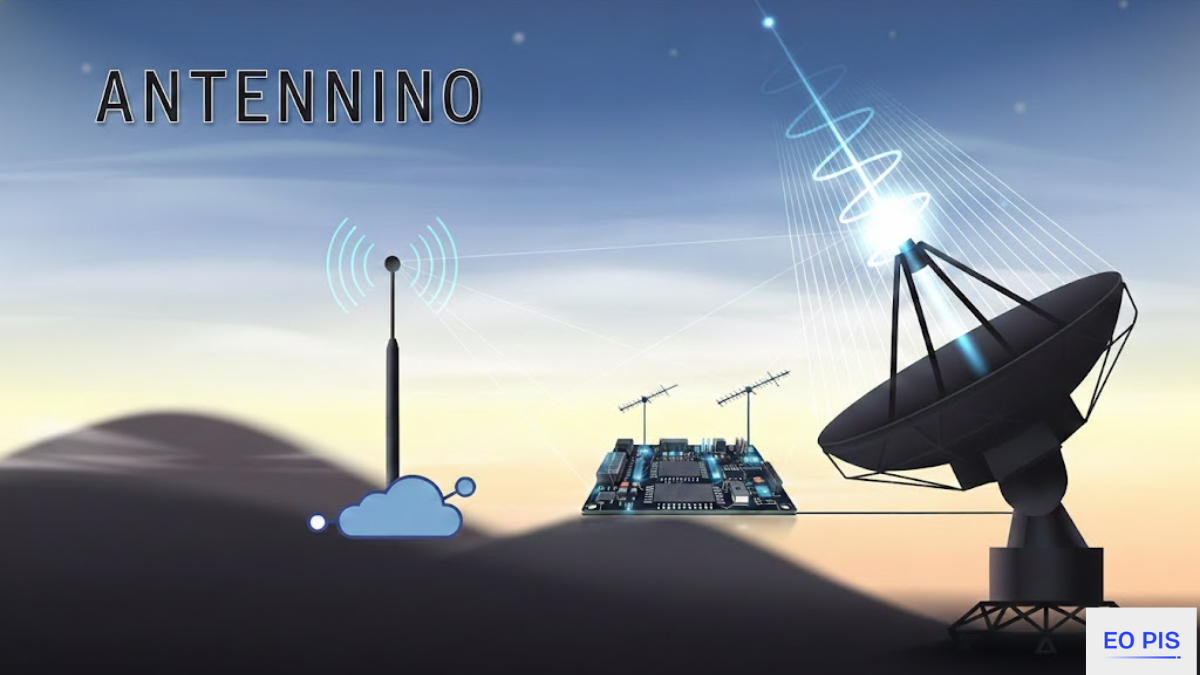
The Internet of Things (IoT) is rapidly transforming smart technology, industrial automation, and home automation, but real progress depends on hardware that balances wireless communication, energy efficiency, and long-term reliability. This is where Antennino stands apart. Designed as an Antennino IoT board, it functions as a low-power wireless board, an Arduino-compatible IoT board, and a purpose-built wireless microcontroller board for real-world deployments.
Unlike generic options in the IoT development board market, Antennino is engineered as a low-power IoT platform and wireless sensor network board that supports remote monitoring, distributed sensor networks, and scalable IoT systems with exceptional stability.
What Is Antennino, Really?
Antennino is an open-source hardware solution created for long-range, battery-operated IoT deployments. It merges the familiarity of Arduino development with integrated radio hardware, removing the need for external modules. Built around the ATmega328P and equipped with the RFM69 RF transceiver, it delivers secure wireless communication at 433 MHz frequency, ideal for remote field deployment. Because it supports Arduino IDE programming and PlatformIO support, developers can build embedded systems quickly without proprietary toolchains.
More than a simple wireless microcontroller board, Antennino is a sensor-ready platform with GPIO expansion, ready for sensor integration in environmental monitoring, smart agriculture, and precision farming projects.
Where Antennino Actually Shines in Real Projects

Many IoT development boards perform well in labs but struggle outdoors. Antennino excels in wireless automation tasks where battery life optimization and long-range communication are critical. In smart city infrastructure, environmental monitoring, and industrial automation, Antennino nodes quietly collect data, transmit through mesh networks, and return to deep sleep cycles, maintaining ultra-low power consumption.
This makes it a natural fit for remote monitoring in farms, warehouses, and research installations where changing batteries frequently is impractical.
Core Architecture and Technical Specifications
At its core, Antennino uses the ATmega328P microcontroller combined with the RFM69 radio module. Communication runs through SPI, while peripherals connect through I2C and UART, supporting sensor integration and hardware prototyping. Built-in flash memory enables OTA updates and over-the-air programming, reducing maintenance in large distributed sensor networks.
Security is reinforced through AES-128 encryption, ensuring data integrity and encrypted communication even in open RF environments. This architecture supports edge computing tasks while keeping power draw minimal.
Wireless Behavior, Point-to-Point, Mesh, and Real-World Conditions
Antennino handles wireless communication through structured addressing, making it effective as both a gateway and a node in scalable IoT systems. Using libraries from LowPowerLab and RadioHead, developers can configure mesh networks for resilient data delivery. Unlike Wi-Fi boards, its long-range communication at sub-GHz frequencies ensures stability through walls and outdoor terrain.
Because real environments are noisy, Antennino dynamically adjusts transmission strength, supporting power-conscious design while maintaining consistent connectivity.
Power Consumption, Where Antennino Earns Its Reputation
Power management is Antennino’s defining feature. With PicoPower technology and the TPL5110 timer IC, the board achieves ultra-low power consumption during sleep cycles. This intelligent power management system allows months or even years of operation on standard batteries.
Such microcontroller efficiency is essential for battery-operated IoT and remote field deployment, where energy access is limited.
Battery Power and Power Source Flexibility
Antennino supports AA batteries, LiPo cells, and regulated inputs. Voltage monitoring allows adaptive battery life optimization, helping devices adjust transmission frequency based on remaining charge. This flexibility supports wireless sensor network board installations across smart agriculture, environmental monitoring, and industrial automation sites.
Antennino vs Traditional Arduino Boards
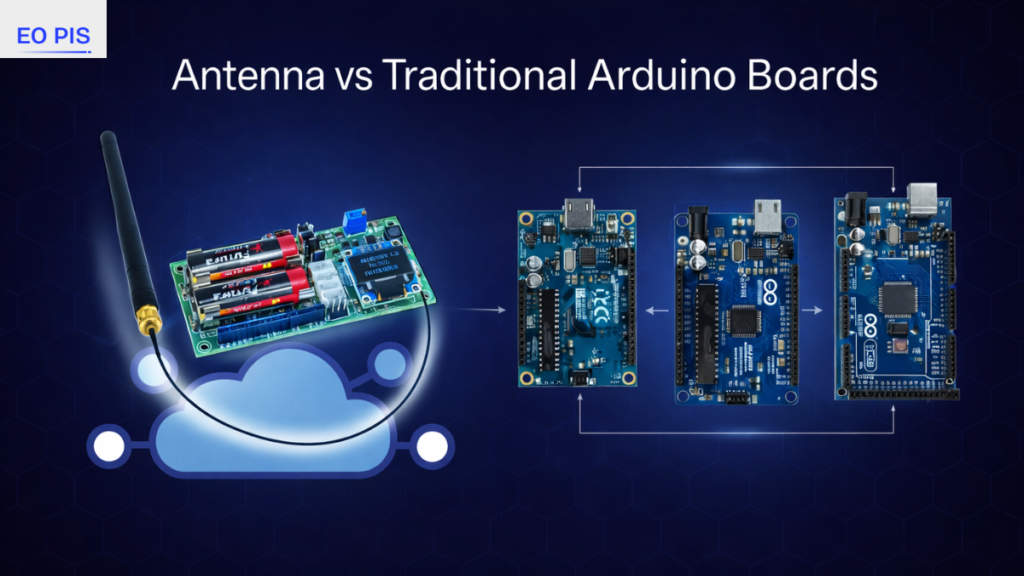
Traditional Arduino boards require external radios for wireless communication and additional circuits for power management systems. This increases complexity and reduces reliability. Antennino, as an Arduino-compatible IoT board, integrates everything needed for secure wireless communication, sensor integration, and battery-operated IoT in one compact design.
Antennino vs ESP8266 and ESP32
Boards like ESP8266 and ESP32 provide Wi-Fi and high processing capability, but consume significantly more energy. They suit mains-powered projects but struggle in remote monitoring roles. Antennino instead focuses on low-power IoT platform performance, pairing long-range radio with edge computing efficiency. When combined with a Raspberry Pi gateway, data can still reach cloud IoT platforms like AWS IoT, ThingsBoard, or Blynk.
First-Time Setup Without the Usual Pain
Getting started with Antennino requires only the Arduino IDE, PlatformIO, and a USB-to-Serial adapter. Libraries from GitHub provide examples for radio setup, over-the-air programming, and OTA updates. This familiar workflow strengthens the developer ecosystem and keeps the platform transparent and trustworthy.
Programming Antennino with Arduino IDE
With Arduino IDE programming, developers write familiar sketches to manage wireless communication, sleep cycles, and sensor integration. Popular peripherals like DS18B20, LDR sensor, Grove connectors, SSD1306, and SH1106 displays integrate easily. This modularity reinforces Antennino’s reputation as a sensor-ready platform built for embedded systems innovation.
Antennino Use Cases and Applications
In smart agriculture, Antennino tracks soil moisture and climate data. In home automation, it handles wireless security and temperature sensing. Industrial automation relies on Antennino for equipment condition tracking, while smart city infrastructure uses it for environmental sensing and traffic monitoring. These deployments highlight its reliability in distributed sensor networks and scalable IoT systems.
Scaling Beyond a Few Devices
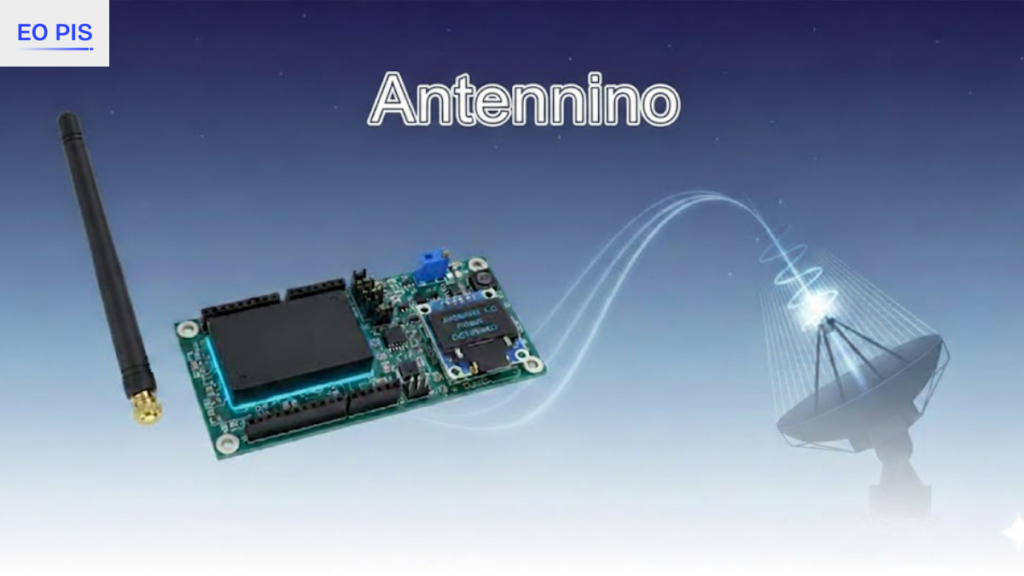
Large networks of Antennino IoT board nodes report data to centralized gateways, enabling cloud IoT platforms and advanced analytics. This architecture separates sensing from processing, supporting efficient edge computing and remote monitoring across wide areas.
The Security Part Everyone Pretends Doesn’t Exist
Security in wireless automation cannot be ignored. Antennino’s AES-128 encryption ensures data integrity, while controlled node addressing prevents unauthorized access. Compared to many hobbyist IoT development boards, Antennino takes secure wireless communication seriously, reinforcing trust in professional deployments
Conclusion
Antennino is more than a wireless microcontroller board. It is a purpose-built low-power wireless board, an Arduino-compatible IoT board, and a complete low-power IoT platform designed for realistic Internet of Things (IoT) deployments. By combining long-range communication, ultra-low power consumption, secure wireless communication, and an open developer ecosystem, Antennino enables distributed sensor networks that run quietly, efficiently, and reliably. For anyone building scalable IoT systems, Antennino delivers the balance of performance, endurance, and simplicity that real-world projects demand.
FAQs
What is Antennino used for?
Antennino is used to build low-power wireless IoT devices that collect and transmit sensor data over long distances. It is ideal for remote monitoring in agriculture, smart homes, and environmental sensing.
How is Antennino different from a regular Arduino board?
Unlike standard Arduino boards, Antennino has a built-in RF transceiver and antenna for wireless communication. It is also optimized for ultra-low power operation, making it better for battery-powered IoT projects.
Does Antennino support over-the-air updates?
Yes, Antennino supports OTA updates through onboard flash memory. This allows firmware to be updated remotely without physically accessing the device.
What wireless range can Antennino achieve?
Using its sub-GHz radio module, Antennino can achieve long-range communication that performs well through walls and outdoor environments. Actual range depends on antenna setup and environmental conditions.
Is Antennino beginner-friendly?
Yes, Antennino is compatible with the Arduino IDE, so beginners can program it using familiar tools. At the same time, it offers advanced features for experienced IoT developers.