Some of the world’s most spectacular national park experiences don’t begin at a trailhead. They begin at the water’s edge.
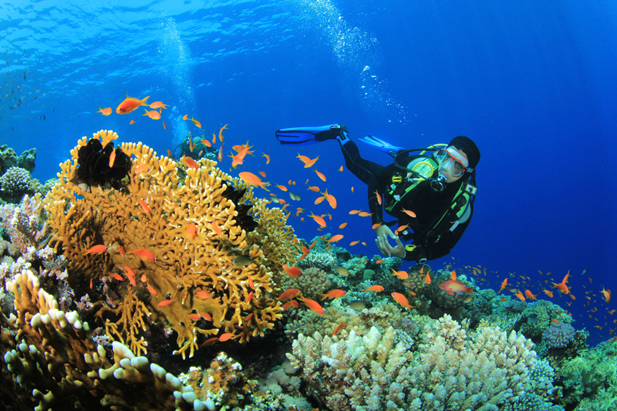
Put on a mask, slip beneath the surface, and an entirely different kind of wilderness appears. Coral gardens replace forests. Sea turtles glide where birds might soar. Sharks patrol the blue like terrestrial predators moving across an open plain. And sometimes, the wildlife seems just as interested in you as you are in it.
For scuba divers and snorkelers, protected waters offer opportunities to experience some of the richest ecosystems on Earth. From Australia’s Great Barrier Reef to the extraordinary wildlife of the Galápagos Islands, these are four places where getting underwater isn’t simply another activity; it is one of the primary reasons to go.
Great Barrier Reef Marine Park: Enter the World’s Greatest Reef
If there is one name almost everyone associates with scuba diving and snorkeling, it is the Great Barrier Reef.
Stretching along Australia’s northeastern coast, this enormous ecosystem includes more than 2,900 individual reefs and supports approximately 1,625 species of fish and more than 450 species of hard coral. Six of the world’s seven marine turtle species occur within the Great Barrier Reef region.
Those statistics are impressive, but numbers don’t really explain what it feels like to enter the water.
A good reef dive begins with that first look beneath the surface. Suddenly, what appeared to be an endless blue ocean from the boat becomes a landscape filled with coral formations and movement. Schools of brilliantly colored fish pass through the reef. A sea turtle may glide slowly overhead. Giant clams sit among the coral, while rays and reef sharks may appear farther out in the blue.
The Great Barrier Reef works particularly well because you don’t have to be an advanced scuba diver to experience it. Snorkelers can explore shallow reef environments where sunlight illuminates the coral and marine life below, while certified divers can descend to deeper reefs, walls and more remote locations.
For experienced divers seeking something beyond the most frequently visited day-trip sites, excursions to the outer reef and longer liveaboard trips can provide a more immersive experience.
The Great Barrier Reef isn’t one dive site. It is an enormous underwater world, and that scale is part of its appeal. You could spend a lifetime exploring it and still have another reef waiting.
Galápagos National Park: Dive with the Wild
The Galápagos Islands and the surrounding national park are famous for what lives on land, but some of their greatest wildlife encounters happen underwater.
The convergence of major ocean currents around the islands creates an unusually productive marine environment. UNESCO describes the Galápagos Marine Reserve as an underwater wildlife spectacle, with marine life ranging from corals and sharks to penguins and marine mammals.
For divers, this can mean encounters with hammerhead sharks, Galápagos sharks, rays, sea turtles, sea lions, fur seals and enormous schools of fish. The Galápagos National Park Directorate manages 91 marine visitor sites where activities can include snorkeling and scuba diving.
What makes the Galápagos different, however, isn’t simply the number of animals.
It is how you encounter them. Sea lions may twist and turn around snorkelers as though inviting them to play. Marine iguanas enter the ocean to feed. Penguins propel themselves through the water with astonishing speed. At sites such as Gordon Rocks, divers can encounter hammerheads, Galápagos sharks, manta rays, eagle rays and sea turtles.
The Galápagos can also demand more from divers. Cold currents, changing visibility and stronger water movement mean some of the celebrated sites are better suited to experienced divers.
Snorkelers shouldn’t feel left out. Places such as Devil’s Crown and Pinnacle Rock can offer remarkable opportunities to encounter sea turtles, sea lions, rays, sharks, penguins and colorful fish close to the surface.
In the Galápagos, you don’t simply observe wildlife from a distance. You enter its world.
Komodo National Park: Dragons Above, Mantas Below
Most people travel to Komodo National Park for one reason: to see a Komodo dragon. Then they discover the water.
The same Indonesian national park protecting the world’s largest living lizard also protects remarkably rich marine ecosystems. Clear water, strong currents and the movement of nutrient-rich deeper water help support diverse coral reefs. The park’s marine environment includes sea turtles, dolphins, dugongs and other marine mammals in addition to an exceptional diversity of reef life.
For many divers and snorkelers, however, the unforgettable encounter is the manta ray.
Watching one of these enormous animals appear out of the blue can stop you in your tracks. Mantas don’t seem to swim so much as fly underwater, their broad fins moving almost effortlessly as they pass through the current.
Komodo also offers colorful reefs, turtles, sharks and dense schools of fish. Strong currents contribute to the ecosystem’s productivity but can also make certain sites challenging, so divers should choose locations appropriate for their experience level.
For snorkelers, guided excursions can provide access to calmer locations and opportunities to experience manta rays and shallow reef environments without scuba equipment.
Few national parks offer such a dramatic contrast. One day you are walking across a dry Indonesian island behind a ranger searching for giant dragons. The next, you are floating above a coral reef while a manta ray passes beneath you.
Bunaken National Park: Dive Over the Edge
Off the northern coast of Sulawesi, Indonesia, Bunaken National Park offers another of the world’s exceptional underwater experiences.
Bunaken lies within the Coral Triangle, the global center of marine biodiversity. Indonesia’s tourism authority reports that the park supports hundreds of coral species along with a tremendous diversity of fish, mollusks, reptiles and marine mammals.
But Bunaken’s signature experience is its underwater topography. Here, shallow coral reefs can suddenly give way to dramatic walls disappearing into deep blue water.
Descending alongside one of these walls changes your sense of perspective. Coral formations cling to the reef face while schools of fish move above and below. Sea turtles cruise past the wall, and the open water beside you always carries the possibility of something larger appearing.
Sites such as Sachiko’s Point, Ron’s Point, Siladen Jetty, Pangulingan and Barracuda Point are among the area’s recognized diving locations. Snorkeling can be equally rewarding. The shallow portions of the reef allow non-divers to experience Bunaken’s tropical marine environment without descending into deeper water.
For underwater photographers, coral enthusiasts and travelers who simply want to experience the overwhelming abundance of a tropical reef, Bunaken deserves a place among the world’s great diving destinations.
The National Park Experience Below the Surface
We tend to imagine national parks as mountains, forests, waterfalls and wildlife roaming across open landscapes.
But some of the planet’s greatest protected wilderness lies underwater.
The Great Barrier Reef surrounds visitors with the world’s most famous coral ecosystem. The Galápagos brings divers face-to-face with extraordinary wildlife. Komodo combines manta-filled seas with one of the world’s most unusual terrestrial animals. Bunaken invites divers to descend alongside spectacular coral walls into the blue.
Each is different, but they share something important. The moment you put your face beneath the surface; the park becomes bigger. There is another landscape down there; one filled with animals, colors and experiences invisible from shore.
Sometimes the best way to explore a national park isn’t to hike farther. It’s to dive deeper.