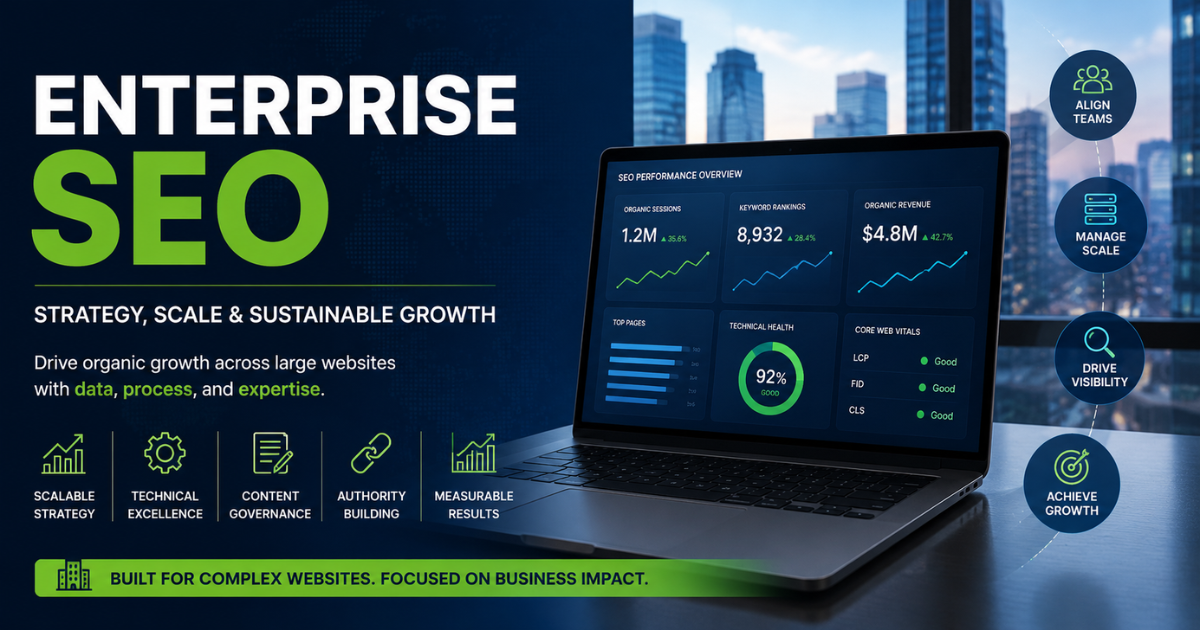
Enterprise SEO is the coordinated practice of improving organic search performance across a large, complex website using scalable technical systems, content governance, automation, and cross-team workflows. It is designed for organizations where thousands or millions of URLs, multiple markets, many stakeholders, and frequent releases make page-by-page SEO impractical.
The main benefit is not simply more rankings. It is the ability to prevent large-scale search problems, prioritize high-impact opportunities, and make SEO repeatable across products, templates, regions, and teams.
What Is Enterprise SEO?
Enterprise SEO applies standard search principles—crawlability, indexability, relevance, authority, and user experience—at organizational scale.
A site does not become an enterprise SEO project only because the company is large. The stronger signal is operational complexity:
- many page types;
- distributed ownership;
- international variants;
- heavy JavaScript;
- frequent deployments;
- multiple domains;
- or a URL inventory too large to manage manually.
Google’s current guidance continues to treat crawlable, indexable, people-first content as the foundation for traditional results, AI Overviews, and AI Mode. Google says there is no separate AI schema or special machine-readable file required for inclusion in its generative search features. urn720764view1
Why Large Websites Need a Different SEO Model
On a small site, an SEO specialist can review individual pages. On a large platform, one template defect may repeat across 100,000 URLs. The challenge shifts from fixing pages to fixing systems.
Typical enterprise problems include:
- faceted navigation creating excessive URL combinations;
- duplicate regional or product pages;
- JavaScript hiding important content or links;
- outdated XML sitemaps;
- inconsistent canonicals, redirects, or hreflang;
- content teams publishing overlapping pages;
- engineering releases creating search regressions;
- reporting that tracks traffic without connecting it to business value.
From what I’ve seen in published large-site audits, the most valuable work removes a systemic constraint rather than polishing isolated pages.
The Four Operating Layers
A practical enterprise program has four connected layers:
| Layer | Main Question | Typical Output |
| Technical foundation | Can search systems discover, render, and index priority pages? | URL rules, templates, sitemaps, canonicals, and monitoring |
| Content system | Does each page type satisfy a distinct user need? | Taxonomy, briefs, entity coverage and refresh rules |
| Authority and discovery | Can users and crawlers reach important pages? | Internal-link modules, navigation and digital PR |
| Governance and measurement | Can teams repeat good decisions without creating regressions? | Ownership, QA gates, dashboards and release controls |
What most guides miss is that the fourth layer often determines whether the first three survive. A technically correct recommendation has little value when no team owns it, no release window exists, or no monitoring detects when it breaks again.
A Real-World Enterprise SEO Workflow
1. Define the searchable inventory
Group URLs by template, purpose, market, status, and business value.
Separate indexable landing pages from:
- filters;
- internal search results;
- account areas;
- duplicates;
- expired inventory;
- tracking parameters;
- and utility URLs.
2. Establish a measurement baseline
Connect search visibility to outcomes such as qualified leads, revenue-assisted sessions, product discovery, sign-ups, subscriptions, or support deflection.
For very large properties, Search Console bulk exports to BigQuery can support daily analysis across more rows than standard interface views. Diagnose by pattern, not anecdote
Sample each major template and compare:
- crawl status;
- indexation;
- canonical selection;
- internal-link depth;
- content uniqueness;
- rendered HTML;
- page performance;
- and conversions.
Log-file analysis can help distinguish URLs that exist in the CMS from URLs search crawlers actually request.
4. Prioritize with impact and confidence
Score potential work using:
- Number of commercially valuable URLs affected
- Expected search or conversion upside
- Risk reduction
- Implementation effort
- Evidence quality
- Time required to validate the result
A high-volume issue is not automatically high priority when it affects low-value pages.
5. Fix the source
Change the CMS rule, component, navigation logic, rendering method, or deployment process that creates the problem.
Avoid manual page-by-page patches unless the affected pages are genuinely exceptional.
6. Validate before and after release
Test representative URLs in staging and production.
Confirm:
- generated HTML;
- robots directives;
- canonicals;
- status codes;
- internal links;
- structured data;
- analytics events;
- and page-template consistency.
For migrations, define rollback criteria and test a lower-risk section before moving the entire site. Google also recommends phased testing where practical for large site moves. Record the decision
Document the change, rationale, owner, release date, validation method, and review date. This prevents repeated debates and creates organizational memory.
Enterprise SEO vs Traditional SEO
Traditional SEO is often campaign-led and page-focused. Enterprise SEO is system-led and portfolio-focused.
| Factor | Traditional SEO | Enterprise SEO |
| Scope | Dozens or hundreds of pages | Thousands to millions of URLs |
| Main unit of work | Individual page | Template, rule or platform |
| Coordination | Small marketing team | SEO, engineering, product, legal and regional teams |
| Tooling | Crawlers and rank tracking | APIs, warehouses, log analysis and automated QA |
| Primary risk | Missed optimization | Scaled technical or governance failure |
| Success measure | Rankings and traffic | Business value plus risk prevention |
In real use, enterprise teams need both models. Strategic pages may still require expert editorial work, while repetitive page types need controlled templates and quality thresholds.
Where Enterprise SEO Commonly Fails
A common mistake is creating a large audit without a delivery system. Hundreds of findings become a backlog, priorities change, and the same defects return.
This may fail when:
- SEO is consulted only after product decisions are final;
- teams optimize for URL count instead of useful indexed inventory;
- automation publishes thin pages faster than reviewers can govern them;
- canonical tags are treated as a substitute for controlling duplicate generation;
- dashboards report averages that hide template or country-level losses;
- international expansion translates words without adapting intent or offers;
- Core Web Vitals becomes a vanity score rather than one part of user experience.
Google recommends good Core Web Vitals, but it also explains that strong scores alone do not guarantee top rankings. A practical fix is to build SEO into product requirements, design systems, CMS permissions, release checks, and business reporting.
Experience-Based Content Blocks
Experience Block 1: Real Use Workflow
How a Team Would Evaluate an Enterprise Website
- Segment the site first.
Divide URLs by directory, template, market, product type, indexability, and commercial importance. - Compare inventories.
Compare CMS URLs, XML sitemap URLs, crawled URLs, indexed URLs, organic landing pages, and server-log requests. - Identify mismatches.
Look for valuable pages absent from internal links, outdated pages remaining in sitemaps, duplicate filters being crawled, or indexed pages receiving no impressions. - Select representative samples.
Inspect examples from each template instead of randomly reviewing individual pages. - Locate the generating rule.
Determine whether the issue comes from the CMS, frontend component, routing system, API, navigation, or content workflow. - Estimate commercial impact.
Separate pages that serve real demand from URLs that merely increase the site’s total page count. - Implement a controlled fix.
Test the correction on a limited template group before wider deployment. - Monitor the result.
Review crawl behavior, indexation, impressions, conversions, and unexpected side effects.
Common Real-World Issue
A product-filter system creates millions of crawlable parameter combinations, even though only a small number satisfy unique search demand.
Practical Fix
Create an explicit indexable-filter policy. Allow valuable category combinations, consolidate duplicates, block or remove low-value combinations, update internal links, and keep XML sitemaps limited to canonical URLs.
Google warns that faceted navigation can produce a near-infinite URL space and consume crawling resources that could otherwise be used for important pages. Experience Block 2: Realistic Scenario
Scenario
A multinational software company operates 14 country folders. Each region publishes landing pages independently, and several markets translate the same English pages without adapting examples, search intent, proof, or product availability.
What Worked
- Assigning one global topic owner
- Creating a shared entity and terminology framework
- Defining which content should be global, localized, or market-specific
- Adding bidirectional hreflang annotations
- Measuring performance by country and template
- Allowing regional teams to add local proof, regulations, integrations, and offers
Google requires alternate hreflang pages to reference themselves and corresponding variants, and bidirectional relationships are important for the annotations to be processed correctly. It Did Not Work
- Literal translation of every global page
- Publishing one page per keyword variation
- Automatically creating regional URLs where the product was unavailable
- Using hreflang to compensate for weak or duplicate regional content
- Reporting international performance only as one global total
What Most People Overlook
International SEO is not just a tagging task. It involves product availability, legal restrictions, local terminology, customer proof, currencies, support options, and regional search intent.
Enterprise SEO in 2026
The 2026 priority is not to create separate content for classic search, AI Overviews, and AI Mode.
Google states that established SEO practices remain relevant and that pages must be indexed and eligible for snippets to appear as supporting links in its AI features. It also recommends accessible text, crawlable internal links, useful images, videos, accurate structured data, and updated business or product information. National change is measurement. Google announced dedicated generative-AI visibility reports in Search Console on June 3, 2026, initially rolling them out to a subset of websites. Enterprises should verify report availability before promising AI-feature metrics because availability and fields may change. Testers should also review crawl efficiency. Google’s July 2026 crawl-budget guidance emphasizes managing URL inventory, duplicates, robots rules, status codes, sitemaps, redirect chains, and page efficiency. Its example thresholds are rough, so teams should diagnose actual crawl and indexing symptoms rather than assume every large website has a crawl-budget problem. terprise SEO Worth It?
Enterprise SEO is worth investing in when search demand is commercially meaningful and website complexity creates recurring risks or missed opportunities.
It is best suited to:
- marketplaces;
- publishers;
- SaaS platforms;
- ecommerce catalogs;
- franchises;
- international brands;
- universities;
- healthcare networks;
- and organizations with multiple web properties.
Do not build a heavy program for a small, stable site with limited search demand. Use a simpler model until scale, release frequency, or revenue exposure justifies more governance.
Before selecting an agency, platform, or internal team, check whether it can:
- diagnose template-level causes;
- work with engineering and product roadmaps;
- connect search metrics to business outcomes;
- manage international and legal constraints;
- automate monitoring without automating low-value content;
- explain uncertainty;
- and validate impact after deployment.
Conclusion
Enterprise SEO turns search optimization from a collection of page edits into an operating system for discoverability.
The strongest programs reduce wasted URLs, improve high-value templates, protect releases, coordinate teams, and measure outcomes beyond traffic.
Start with inventory, ownership, and measurement—not a giant keyword list. Fix one high-impact system, prove the result, and then scale the workflow across templates, markets, and teams.
FAQs
1. Is enterprise SEO worth the cost?
Enterprise SEO is worth the cost when organic search materially affects revenue and website complexity creates recurring risks. A smaller, stable site may gain more from a focused SEO program than from expensive enterprise tooling or governance.
2. What is enterprise SEO in simple terms?
Enterprise SEO is search optimization designed for large or operationally complex websites. It focuses on improving templates, systems, data, and team workflows rather than editing every page individually.
3. How many pages make a website enterprise-level?
There is no universal page-count threshold for enterprise SEO. A 20,000-page website with daily updates and several markets may be more complex than a static website containing one million pages.
4. Does enterprise SEO still matter when people use AI search?
Yes, enterprise SEO remains important because AI search features depend on accessible, indexable, useful web content. Google says its established SEO best practices continue to apply to AI Overviews and AI Mode. What is the biggest hidden risk in enterprise SEO?