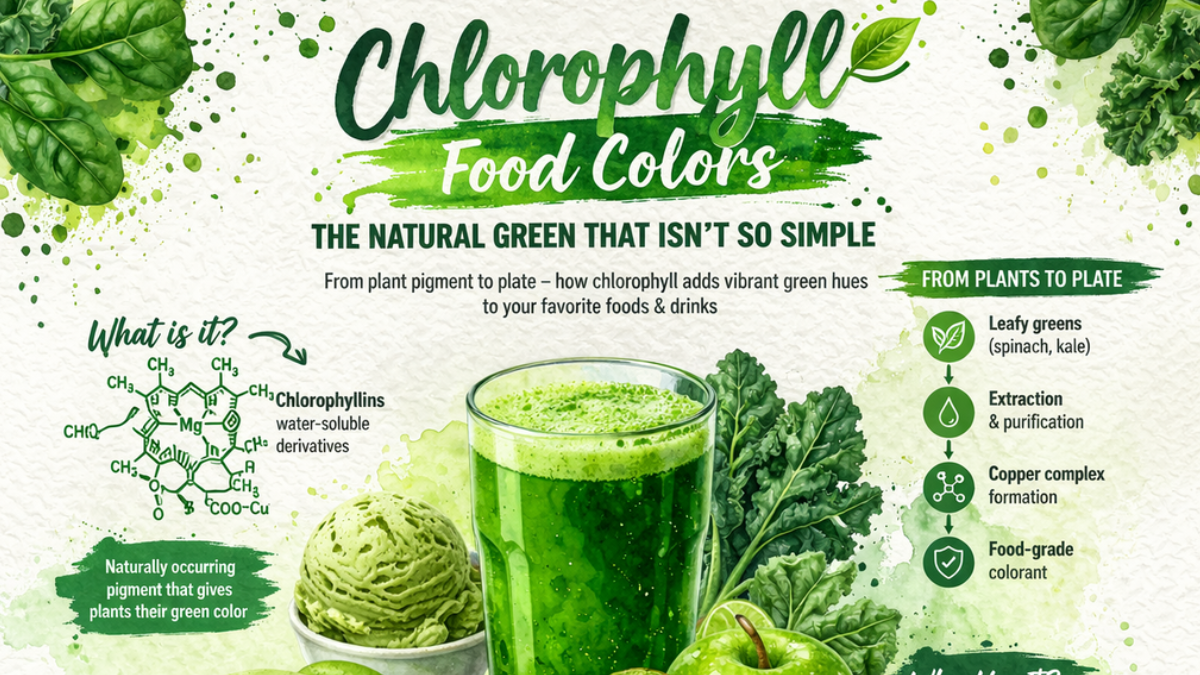
Green is one of the most powerful colors in food. It signals freshness, health, and a connection to nature. Whether it’s a mint drink, a pistachio dessert, or a plant-based snack, green plays a huge role in how we perceive the product.
And at the heart of many of these shades lies one ingredient—chlorophyll.
Often described as the most “natural” way to achieve green, chlorophyll food colors seem like an obvious choice. But in reality, they come with a unique set of challenges that both manufacturers and brands must navigate carefully.
What Is Chlorophyll Food Coloring?
Chlorophyll is the pigment that gives plants their green color and helps them absorb sunlight for photosynthesis.
For food applications, chlorophyll is typically extracted from:
- Spinach
- Alfalfa
- Nettle leaves
- Other green plant sources
It is then processed into forms that can be used in food and beverage formulations.
There are generally two types used in the industry:
- Oil-soluble chlorophyll
- Water-soluble chlorophyll derivatives (like chlorophyllin)
Each serves different applications depending on the product.
Why Chlorophyll Appeals to Food Brands
On paper, chlorophyll ticks all the right boxes.
It is:
- Plant-derived and label-friendly
- Recognizable to consumers
- Aligned with clean-label trends
- Suitable for “natural” positioning
In a market where ingredient lists are under scrutiny, chlorophyll offers something synthetic colors cannot—familiarity and trust.
But this is only one side of the story.
The Stability Problem No One Talks About
If chlorophyll is so ideal, why isn’t it used everywhere?
The answer lies in its instability.
Chlorophyll is highly sensitive to environmental conditions. It can:
- Turn olive-brown when exposed to heat
- Fade under light
- Break down in acidic conditions (low pH)
This makes it particularly difficult to use in products like:
- Carbonated beverages
- Fruit juices
- Long shelf-life items
For brands, this creates a major risk. A product that looks vibrant during production may lose its appeal by the time it reaches the consumer.
How Manufacturers Work Around These Challenges
This is where formulation expertise becomes critical.
Instead of relying on raw chlorophyll alone, manufacturers often:
- Use chlorophyllin, a more stable derivative
- Apply protective processing techniques
- Combine chlorophyll with other natural pigments
- Adjust formulations to improve pH compatibility
These approaches help improve performance, but they also require careful balancing. Too much processing can move the ingredient away from being perceived as “purely natural,” while too little can lead to poor stability.
Where Chlorophyll Works Best
Despite its limitations, chlorophyll food coloring performs well in certain applications.
It is commonly used in:
- Bakery products (where pH is less acidic)
- Dry mixes and seasonings
- Confectionery coatings
- Dairy products like ice cream and spreads
In these environments, the color is more likely to remain stable and visually appealing.
The Role of Innovation in Chlorophyll-Based Colors
The demand for natural green shades is growing faster than ever, and chlorophyll remains a key part of that demand.
To keep up, manufacturers are investing in:
- Improved extraction methods
- Encapsulation technologies for better protection
- Blended systems for enhanced stability
- Application-specific solutions
The goal is not just to offer a natural food colors, but to make it functional and reliable across a wide range of products.
Choosing the Right Approach
For food brands, the decision to use chlorophyll food coloring shouldn’t be taken lightly.
It requires asking the right questions:
- What is the product’s pH level?
- Will it be exposed to heat during processing?
- What is the expected shelf life?
- How important is color consistency over time?
In many cases, success depends less on the ingredient itself and more on how well it is applied.
Final Thoughts
Chlorophyll food colors represent the promise—and the complexity—of natural ingredients.
They offer a clean, plant-based way to achieve green shades, but they also demand a deeper level of technical understanding. Without the right formulation strategy, even the most natural ingredient can fall short.
As the food industry continues its shift toward cleaner labels, chlorophyll will remain an important player. But its success will depend on how well manufacturers and brands work together to overcome its limitations.
Because in the end, creating a natural product isn’t just about what goes on the label—it’s about how well it performs in the real world.
Read More https://eopis.co.uk/