What the Work Really Involves and How to Get It Done Right
A homeowner’s guide to tree surgery, emergency tree work, stump removal and garden maintenance in Luton, Stevenage and across Hertfordshire
Most people do not think about their trees until something forces them to. A branch comes down in a storm and lands on the shed roof. A neighbour mentions, politely but firmly, that the oak by the back fence is dropping large limbs into their garden. The surveyor’s report on a potential house purchase flags a T1 ash within root distance of the foundations. A tree that was alive last spring has not come into leaf this year.
At that point, the search for a tree surgeon begins in earnest, and in towns like Luton and Stevenage, the quality of operators available varies considerably. Some are highly skilled arborists with proper qualifications, insurance and equipment. Others are general garden contractors who have added tree work to their list of services without the training that makes it safe.
This guide covers what you actually need to know before booking a tree surgeon in Luton or Stevenage: the services you might need and why, the regulatory considerations that apply in both areas, the questions to ask any contractor before they start work, and what makes the difference between a job that goes smoothly and one that does not.
Tree surgeons in Luton: serving a diverse and growing town
Luton presents a distinctive mix of tree surgery contexts. The town has large areas of post-war and newer housing where gardens are modest in size but trees are often close to boundary fences, garages and extensions. It also has older residential streets with more established trees, and pockets of significant green infrastructure including Wardown Park and Stockwood Park. This mix means that tree surgeons working regularly in Luton need experience across a broad range of scenarios.
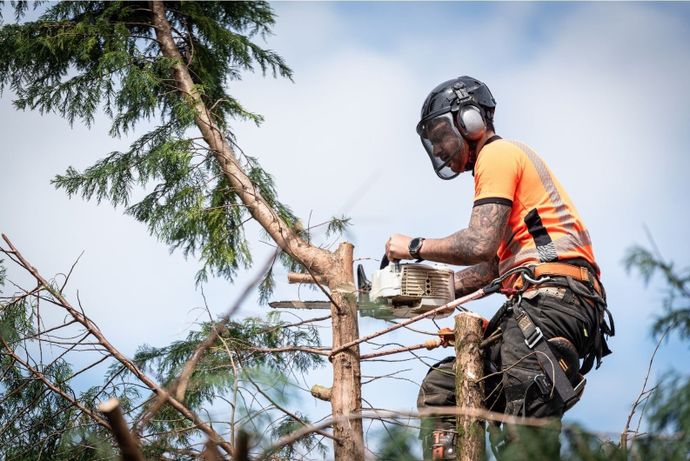
One of the more common requests in Luton is for tree removal in restricted-access gardens. Where large equipment cannot reach and manual section-by-section dismantling is required, the premium on skill, experience and the right small-equipment package is high. A tree surgeon who regularly works in Luton’s suburban gardens will have the methodology for this. One who typically works on more open rural sites may struggle with the constraints.
Luton falls within the jurisdiction of Luton Borough Council, which administers Tree Preservation Orders independently of the county framework. TPOs in Luton tend to be concentrated around older residential areas and parks. If you are planning work on a large or mature tree in Luton, checking the council’s planning portal for any existing TPO before contacting contractors is worth doing, as it will affect the timeline and process of any application for consent.
Hedges in Luton properties are also subject to the High Hedges legislation under Part 8 of the Anti-Social Behaviour Act 2003, which allows homeowners to complain to the council about a neighbour’s hedge that is over 2 metres tall and blocking light to their property. Before a formal complaint is made, a reasonable attempt at resolution with the hedge owner is expected. A professional tree surgeon who can provide a written assessment of the hedge and an appropriate management proposal can help resolve these disputes before they reach the council.
For homeowners and landlords in Luton requiring professional, insured tree surgery, Price Tree & Garden Services’ tree surgeons in Luton operate regularly across the town, bringing the same standards of care and workmanship that have earned them consistently strong reviews from customers across Hertfordshire.
Tree surgeons in Stevenage: new town, mature trees
Stevenage is Britain’s first designated new town, and its planned structure includes significant areas of greenspace woven between the residential neighbourhoods. Many of the trees planted as part of the original development are now 60 to 70 years old and approaching the end of their planned lifespan or requiring significant management. Alongside these planned trees, the older parts of the town, particularly the original Old Town on the High Street, have mature tree stock that is both ecologically valuable and structurally demanding.
Stevenage Borough Council takes an active approach to its tree estate. TPOs are in place across a number of residential areas, particularly around the older housing. The council’s tree officer is involved in assessing applications for work on protected trees and will inspect the tree and the proposed work as part of the consent process. This process typically takes up to eight weeks, which is a significant lead time if the work is for amenity reasons. It does not apply to genuinely urgent safety situations.
A practical issue that Stevenage homeowners sometimes face is the distinction between a tree on their land and a tree whose roots or branches extend from neighbouring land or from public green space. In English law, you have the right to cut back branches and roots that encroach on your property up to the boundary line, but you must offer the cuttings back to the tree owner and you cannot claim compensation for any work you carry out yourself. For trees that may be subject to a TPO, this right does not extend to work that would require consent if done by the owner.
Price Tree & Garden Services’ tree surgeons in Stevenage are familiar with both the practical demands of tree work in this area and the regulatory context within which it operates. For straightforward amenity pruning and removal on unprotected trees, they can often be on site quickly. For work on TPO trees, they can advise on the application process and provide the supporting documentation that councils require.
Emergency tree work: when you cannot wait for a scheduled appointment
Storm damage is the most common driver of emergency tree work in Hertfordshire. The county sits in the path of Atlantic weather systems moving across southern England, and autumn and winter storms can bring down major limbs or whole trees in a single night. The damage pattern is predictable: shallow-rooted species on saturated ground are most vulnerable, as are trees with significant crown sail area and root systems already weakened by disease or drought.
Emergency work on a fallen or partially fallen tree divides into three stages. Immediate safety: the priority is removing any immediate hazard to persons, vehicles and structures. This means clearing the road or driveway, removing weight from a damaged roof, or securing a hanging limb that is liable to fall further. Secondary clearance: once the immediate danger is addressed, the remaining structure of the tree is assessed and the decision is made whether to remove it entirely, reduce it, or leave it for a scheduled visit. Final clearance: the debris, brash and remaining stump are dealt with to restore the site.
If the fallen tree has damaged a boundary fence or a neighbour’s property, the question of liability arises quickly. In English law, a tree owner is not automatically liable for damage caused by a fallen tree unless they were aware of a defect or risk and failed to act on it. A property that had a recent arboricultural assessment confirming the tree was healthy and well-maintained is in a significantly stronger position than one where concerns had been raised and ignored. This is one of the most practical arguments for routine tree inspection, beyond the obvious benefit of catching problems before they become dangerous.
For emergency situations involving fallen trees, hanging limbs or storm damage across Luton, Stevenage, Watford, St Albans and the wider Hertfordshire area, Price Tree & Garden Services responds promptly to urgent enquiries. Call +44 7490 080010 for an immediate response. The team is equipped for emergency clearance and can make a property safe quickly while a longer-term plan for the tree or its remains is decided.
Stump grinding and removal: finishing the job properly
The decision to leave a stump after tree removal is understandable in the short term. The tree is gone, the immediate problem is resolved, and the additional cost of stump grinding can feel like a reason to defer it. In practice, most homeowners who defer it end up wishing they had not.
A stump left in the ground will typically produce vigorous regrowth from the base within one growing season, particularly from species like cherry, elder, hawthorn and most deciduous trees. Treating the regrowth with herbicide is a cycle that rarely fully eliminates the stump’s productivity. More seriously, the decaying wood of an old stump is a primary source of Honey Fungus infection, a pathogen that spreads through the soil and attacks the roots of adjacent woody plants. Honey Fungus is one of the most damaging tree diseases in UK gardens and, once established, is extremely difficult to eradicate.
Stump grinding resolves all of these issues in a single operation. A stump grinder reduces the stump and major surface roots to wood chip to a depth of 150 to 300mm below the original ground level, depending on the intended use of the space. If the area is to be returfed or replanted, deeper grinding gives more clearance. If it is simply to remove the visual obstruction and regrowth risk, shallower grinding is sufficient. The resulting wood chip can be left as mulch, incorporated into the soil or removed from site.
For homeowners across Luton, Stevenage and Hertfordshire with stumps that need removing, Price Tree & Garden Services offers stump grinding as a standalone service, not just as an add-on to a tree removal. If you have stumps from previous work that were never ground, they can be dealt with efficiently in a single visit regardless of when the original removal took place.
Hedge trimming and garden maintenance: the services that keep properties looking their best
Tree surgery is the headline service, but the routine maintenance work that frames a property, namely hedge trimming, shrub management and general garden clearance, is what most homeowners in Luton, Stevenage and across Hertfordshire need most consistently. A well-maintained hedge defines a boundary, provides privacy and wildlife habitat, and adds to kerb appeal in ways that almost nothing else in a garden can replicate.
The best time to trim most formal hedges in Hertfordshire is late summer, typically August, after the main growing season and before birds begin nesting for any second brood. A second light trim in late winter before new growth begins in March and April keeps hedges tight and well-defined through the year. Conifers, which are the most common hedge species in residential Hertfordshire, should not be cut back into old, brown wood: they do not regenerate from old wood and cutting too hard will produce permanent brown patches.
Price Tree & Garden Services covers hedge trimming, garden maintenance and all tree surgery services across Luton, Stevenage, Watford, St Albans and the wider Hertfordshire area. For a free quote on any tree or garden work, call +44 7490 080010 or visit pricetreeandgardenservices.co.uk. The team provides transparent, itemised quotes with no hidden charges, turns up on time, and consistently cleans up to a standard that the reviews reflect.