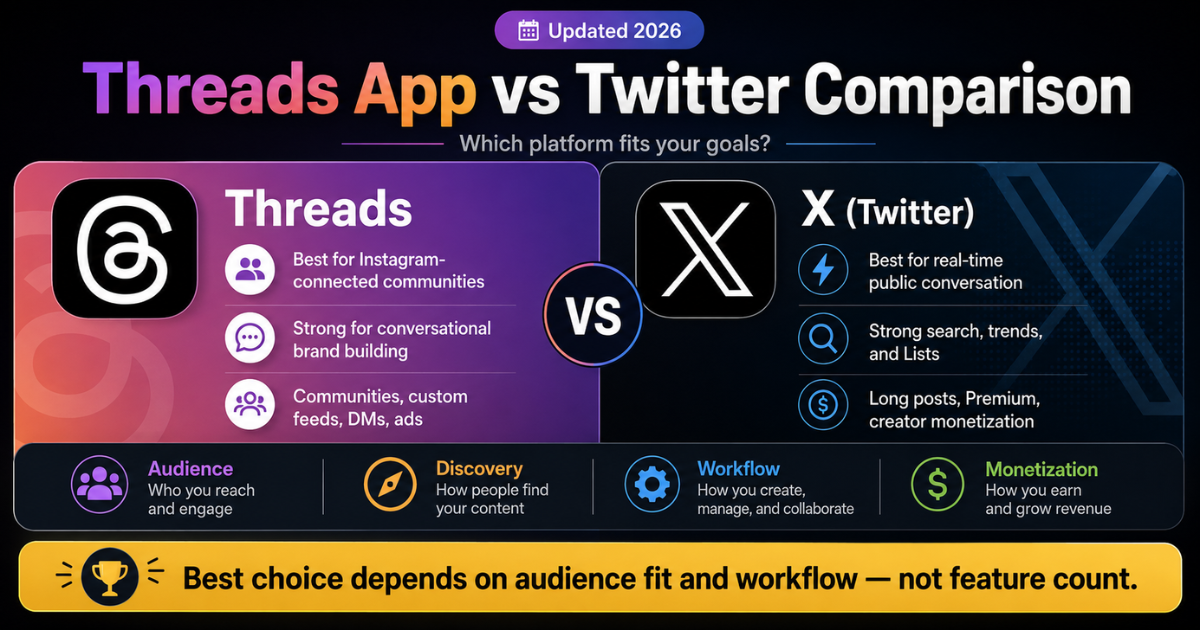
The practical answer is simple: Threads is usually better for Instagram-connected communities, conversational brand building, and lower-friction audience transfer, while X—still commonly searched as Twitter—is usually better for breaking-news monitoring, advanced public search, long-form posts, and built-in creator monetization. Most creators and brands should choose based on audience behavior, not feature count.
A Threads App vs Twitter comparison in 2026 is no longer a comparison between a basic newcomer and a mature network. Threads now includes direct messaging, public Communities, live-event chats, custom feeds, web publishing tools, advertising, and optional fediverse sharing. X retains a broader paid-feature and monetization ecosystem, including Premium tiers, long posts, creator subscriptions, and revenue sharing.
What Are Threads and Twitter/X?
Threads is Meta’s text-focused social platform connected to Instagram. Users sign in through Instagram, can carry over their username and follow familiar accounts, and can publish text, links, images, polls, and video. Standard Threads posts support up to 500 characters; longer text can continue as an added thread.
Twitter was renamed X, but many people still use “Twitter” when searching or describing the platform. X remains centered on public posts, live commentary, searchable conversations, and event-driven discussion. Standard posts support 280 characters, while eligible Premium users can publish substantially longer posts.
Threads vs X at a Glance
| Factor | Threads | X |
| Best starting advantage | Existing Instagram graph | Existing X audience and public-interest graph |
| Conversation style | Interest-led creator and community discussion | Fast public commentary and breaking events |
| Standard text length | 500 characters, with automatic continuation | 280 characters; longer posts are a paid feature |
| Discovery tools | Custom feeds, topics, Communities, search, recommendations | Search, hashtags, trends, Lists, Communities |
| Private messaging | One-to-one and group DMs | Established direct messaging |
| Open-network option | Optional fediverse sharing | Primarily a closed platform ecosystem |
| Creator monetization | Indirect brand, campaign, and Meta-ecosystem opportunities | Revenue sharing and paid creator subscriptions for eligible accounts |
| Paid user tier | No direct equivalent to X Premium for ordinary posting | Basic, Premium, and Premium+ subscriptions |
Feature access, eligibility, pricing, and regional availability can change, so verify the platform help pages before publishing or making a buying decision.
Where Threads Is Stronger
Threads has the clearest advantage when a creator or company already has an active Instagram audience. The ability to log in with Instagram, preserve identity signals, and quickly follow familiar accounts reduces the cost of building an initial network.
It also offers a useful environment for conversational brand presence. Communities, topic tags, reply approvals, custom feeds, and recommendation-driven discovery can help a specialist account become visible beyond its followers. Meta has also added scheduling, insights, drafts, web tools, and global advertising access, making Threads more practical for content teams than it was at launch.
From what I’ve seen in platform migrations generally, the audience-transfer advantage matters more than minor feature differences. A brand with strong Instagram recognition may gain traction on Threads faster than it would by rebuilding relationships elsewhere.
Where X Is Stronger
X is still better suited to users who need to monitor rapidly changing public conversations. Its search tools support keywords, hashtags, accounts, and ongoing discussions, while Lists and Communities help users separate sources and topics.
X also provides a clearer native monetization path for eligible creators. Its current tools include creator subscriptions and revenue sharing, although eligibility, payout terms, policy compliance, and platform discretion create meaningful risk.
For writers, analysts, journalists, sports commentators, and finance or policy observers, the combination of searchable public discussion and long-form paid posting may be more useful than Threads’ Instagram connection. This is a practical advantage, not a guarantee of reach or income.
In Real Use: Choose by Workflow, Not Popularity
In real use, the best platform depends on what you do every week.
- Define the outcome: community conversation, customer support, live-news visibility, lead generation, or creator income.
- Audit where your audience already follows and replies to you.
- Publish the same three content ideas in platform-native formats for four weeks.
- Track meaningful replies, profile visits, qualified clicks, saves, follows, and conversion actions.
- Compare time spent moderating with the value produced.
- Keep one primary platform and use the other selectively when both contribute.
A practical way to check this is to measure qualified conversations per hour, not just impressions. Ten relevant replies from potential customers or peers may be more valuable than 50,000 passive views.
What Most Comparisons Miss
What most guides miss is that the main cost is operational fragmentation. Running two networks means two editorial rhythms, two moderation queues, two analytics views, and different community expectations.
Cross-posting everything saves time but often produces weaker results because a post built for Instagram-adjacent Threads culture may feel misplaced in a fast news cycle on X.
Another overlooked factor is network portability. Threads’ optional fediverse connection can extend public visibility across compatible servers, but it also introduces unfamiliar identity, moderation, and interaction patterns. The feature is meaningful for open-web advocates, yet it is not automatically useful for every brand.
Common Mistakes and Failure Scenarios
A common mistake is choosing the platform with the loudest headlines rather than the platform where the intended audience takes action.
Threads may fail when your topic depends on second-by-second news monitoring, specialist search habits, or an audience that has not moved from X. X may fail when your growth plan depends heavily on Instagram relationships, a softer conversational tone, or an unpaid strategy that assumes Premium features and monetization access are unnecessary.
Both platforms can also fail when teams post without moderation rules, escalation procedures, link tracking, or a clear response policy. Safety controls exist, but they do not eliminate harassment, impersonation, misinformation, account restrictions, or brand-suitability concerns.
2026 Decision: Which Should You Use?
Choose Threads when you have Instagram momentum, want interest-based conversation, value Meta’s publishing and advertising ecosystem, or want to experiment with fediverse distribution.
Choose X when real-time search, breaking events, long posts, paid subscriptions, or native creator monetization are central to the strategy.
Use both only when each has a defined role. For example, a software company could use Threads for founder-led community discussion and X for release monitoring, technical-support signals, and industry news.
The final recommendation is to run a measured four-week pilot before committing resources. Keep the platform that generates the strongest combination of qualified conversation, audience fit, manageable risk, and business value.
Recheck features, prices, policies, and regional availability before publishing this Threads App vs Twitter comparison because both products continue to change quickly.
Experience 1: Real Use Workflow
How to Evaluate Threads and X in Practice
- Select one measurable objective.
Examples include newsletter sign-ups, product-feedback conversations, event visibility, customer-support signals, or creator revenue. - Identify ten audience accounts on each platform.
Include customers, peers, industry publishers, communities, and potential collaborators. - Create three native content formats.
Use a short opinion, an educational post, and a question-led conversation starter. - Adapt rather than duplicate.
Make the Threads version more conversational and context-rich. Make the X version more concise, searchable, and event-aware where appropriate. - Respond for 30 minutes after publishing.
Early interaction helps reveal whether the platform contains the right people—not merely whether the algorithm produces views. - Record outcome quality.
Track qualified replies, relevant follows, click quality, direct conversations, conversions, and moderation time. - Review after four weeks.
Keep the network with the best value-to-effort ratio.
Common Real-World Issue
A post receives many impressions but almost no replies, clicks, profile visits, or identifiable business value.
Practical Fix
Rewrite the post around a specific audience problem and include a question that a qualified reader can answer. Measure useful interactions rather than treating reach as the final outcome.
Comparison and Decision Framework
| Option | Best For | Strength | Weakness | Risk | Final Verdict |
| Threads | Instagram-active creators, lifestyle brands, community builders, conversational experts | Lower-friction Instagram connection, interest communities, Meta publishing ecosystem, fediverse option | May be less useful for highly specialized real-time monitoring | Medium: dependence on recommendations and Meta ecosystem | Best when Instagram audience overlap is meaningful |
| X | News observers, analysts, journalists, technical communities, event commentators, monetizing creators | Public search, live commentary, Lists, long paid posts, subscriptions, revenue sharing | Paid tiers and higher operational or moderation complexity may affect value | Medium to high: policy, monetization, safety, and brand-suitability changes | Best when real-time information and public discovery are essential |
| Threads and X | Teams with separate audience objectives and enough resources | Broader coverage and diversified community access | Doubles workflows unless roles are clearly separated | High if content is duplicated without strategy | Use only when each platform has a defined job |
| Mastodon or another specialist network | Users prioritizing decentralization, niche communities, or greater server choice | Community specificity and open-network principles | Smaller or fragmented audience may require more onboarding | Medium: server governance and audience fragmentation | Evaluate when portability or community control outweighs mass reach |
| Neither as a primary channel | Businesses whose audience converts through search, email, video, forums, or private communities | Protects focus and budget | Reduces participation in public social discussion | Low when supported by strong owned channels | Valid when social activity does not produce measurable value |
Choose Threads if…
- You already have meaningful Instagram recognition.
- Your content performs through conversation, personality, or community participation.
- You use Meta’s publishing and advertising ecosystem.
- You value the option of fediverse sharing.
- Native creator payouts are not the primary objective.
Choose X if…
- You monitor breaking stories, markets, sports, politics, technology, or live events.
- Search, hashtags, public lists, and fast commentary are central to your workflow.
- You need long-post or creator-monetization options.
- Your target community remains active there.
- You can manage the moderation and policy risk.
Avoid Threads if…
- Your audience has little Instagram or Threads activity.
- Your work depends mainly on specialist real-time search.
- Your team cannot support another recommendation-driven content feed.
Avoid X if…
- You do not need its paid features or public-information workflow.
- Your audience does not participate there.
- Brand-suitability, harassment, or moderation exposure exceeds the likely return.
Best Overall Choice
There is no universal winner. The best overall choice is the platform that produces the most qualified audience action per hour of content and moderation work.
Mistakes, Risks, and Limitations
Common Mistakes
- A common mistake is copying the same text, image, hook, and call to action across both platforms.
- Choosing based on total platform size instead of reachable audience fit.
- Comparing impressions without evaluating who engaged.
- Assuming Instagram followers will automatically become active Threads followers.
- Buying X Premium without a clear use for its paid features.
- Treating creator monetization as guaranteed income.
- Launching a brand account without reply, moderation, or escalation guidelines.
- Ignoring regional pricing, availability, advertising, or policy differences.
Hidden Risks
| Risk | Possible Impact | Practical Response |
| Algorithm dependence | Sudden reach decline | Maintain email, website, search, and other owned channels |
| Account restriction | Loss of audience access | Use strong account security and keep customer relationships off-platform |
| Policy change | Monetization or content eligibility changes | Review official platform policies regularly |
| Weak moderation | Harassment, spam, misinformation, or reputational damage | Define moderation and escalation procedures before publishing |
| Cross-post fatigue | Repetitive content and lower engagement quality | Adapt posts to platform behavior |
| Vanity metrics | High reach with little business value | Measure qualified responses and downstream action |
| Team fragmentation | Higher labor cost and inconsistent voice | Give each channel a defined purpose |
| Outdated comparison content | Loss of reader trust | Display a visible reviewed or modified date |
Failure Scenarios
This may fail when the audience is not active on the selected platform, the content is too promotional, the team cannot respond consistently, or the success metric is disconnected from the business goal.
Threads may underperform for second-by-second information monitoring or specialized audiences concentrated on X.
X may underperform for brands expecting automatic organic distribution, low moderation demands, or guaranteed creator revenue.
Misconceptions
- Threads is no longer simply an app with a basic text feed.
- X is not automatically the best option merely because the topic involves public conversation.
- A larger impression count does not prove stronger audience quality.
- Joining both platforms does not automatically reduce platform risk if the same strategy, audience, and content are duplicated.
- Fediverse support does not make content ownership or portability effortless.
What Most Guides Miss
What most guides miss is the long-term cost of maintaining separate communities. Content creation is only one part of the workload; listening, replying, measuring, moderating, documenting, and escalating issues can consume more time than publishing.
What to Do Instead
Start with one primary outcome, run a limited pilot, preserve owned audience channels, and expand only after one platform demonstrates repeatable value.
FAQs
Is Threads better than Twitter/X in 2026?
Threads is better for users who already have Instagram momentum and want community-oriented conversation, while X is generally stronger for public search, live events, long paid posts, and creator monetization. The better choice depends on where your intended audience responds and takes action.
What is the main difference between Threads and Twitter?
The main difference is their network foundation: Threads is closely connected to Instagram, while X is organized around public-interest conversations and real-time discovery. This affects who you can reach, how content is found, and how quickly a new account can establish relevance.
Can Threads replace Twitter completely?
Threads can replace X for some community, brand, and creator workflows, but not for every real-time information use case. Users who rely on X Search, Lists, live commentary, long posts, or native monetization may still need X.
Is X actually better for engagement than Threads?
Not necessarily, because engagement quality depends on the audience, topic, account history, and measurement method. A smaller number of relevant replies or conversions on Threads may be more valuable than a larger number of low-intent interactions on X.
What is the hidden risk of using both Threads and X?
The hidden risk is operational duplication. Without separate roles, teams create repetitive content, split moderation attention, increase costs, and gain little additional business value.
You May Also Like How to Hide Liked Videos on TikTok