
Critical thinking exercises help you strengthen your critical thinking skills, improve analytical thinking, and develop clearer decision-making skills in both personal and professional contexts. When you develop strong problem-solving exercises and thinking strategies, you begin making decisions based on evidence-based reasoning, objective analysis, and structured thinking rather than impulse or bias. These workplace critical thinking tools support better outcomes, clearer communication, and greater confidence in your decision-making process — whether you’re learning how to improve critical thinking in study, work, or daily life.
Understanding Critical Thinking
Critical thinking refers to the practice of analysing information objectively, evaluating sources, interpreting meaning, and developing reasoned judgment. It involves analytical reasoning, logic-based decision-making, and systematic questioning rather than automatic reactions. This style of evidence-based reasoning helps ensure the evaluation of information is grounded in facts rather than assumptions or cognitive bias.
In fields like behavioural economics and organisational psychology, researchers repeatedly show how mental models and bias shape human behaviour. By engaging in structured thinking, individuals reduce distortion in judgment and improve both professional development and employee performance, particularly in settings that require leadership decision-making and workplace problem-solving.
The Cognitive Advantages of Critical Thinking
Developing strong critical thinking skills produces measurable benefits. Decisions become clearer because they rely on logical frameworks and evidence evaluation, not emotional reactions. Communication improves through increased communication clarity and argument structure, which allows ideas to be expressed persuasively and respectfully.
A major advantage is increased judgment accuracy and bias reduction. As people become more aware of cognitive bias, they can challenge automatic thinking, ask better questions, and reach more balanced conclusions. This supports strategic planning, creative problem-solving, risk assessment, and complex problem analysis, making these skills essential for the modern workplace and lifelong cognitive development.
7 Practical Critical Thinking Exercises
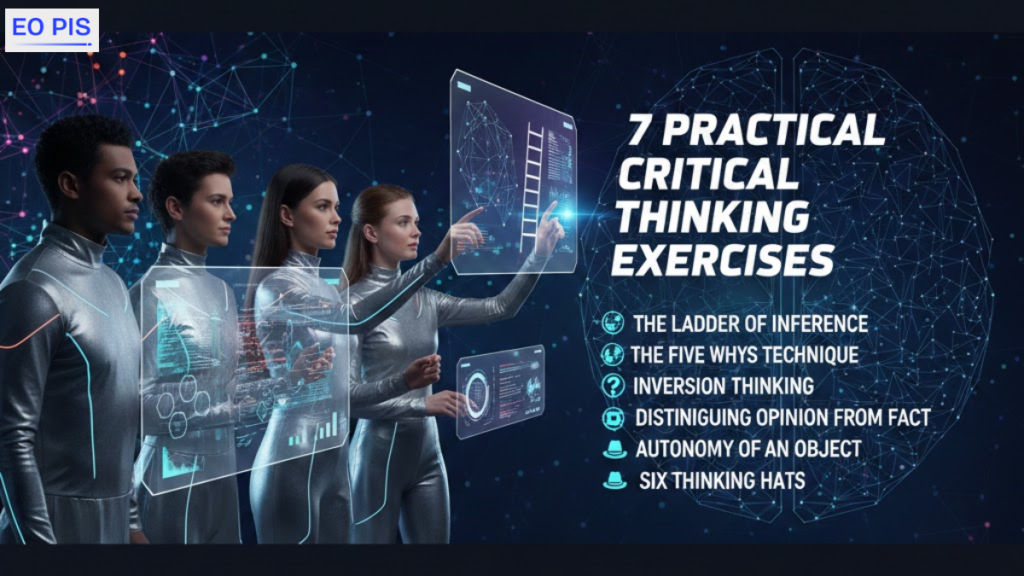
The following critical thinking exercises are widely used in education, leadership development, and corporate learning. They encourage structured thinking, team decision-making, and collaborative problem-solving while improving workplace efficiency and performance.
The Ladder of Inference
The Ladder of Inference, introduced by Chris Argyris, explains how people move from data to action through selected interpretation and assumption formation. This model is now a recognised tool in organisational psychology and leadership coaching. By identifying where assumptions form, you strengthen thinking discipline and prevent unfair conclusions in workplace problem-solving and leadership decision-making.
The Five Whys Technique
The Five Whys Technique, created by Toyoda Sakichi at Toyota, is a classic root cause analysis method. It remains highly effective today in business strategy, performance evaluation, and project planning, because it moves beyond symptoms to identify the real cause driving a problem. It is regularly used in business strategy, risk management, and continuous improvement environments.
Inversion Thinking
Inversion Thinking flips traditional reasoning by asking how failure might occur before planning for success. This approach strengthens strategic thinking, risk assessment, and idea evaluation. It is especially valuable in leadership and market research, where anticipating uncertainty protects employee performance and supports sound business strategy.
Argument Mapping
Argument Mapping visually structures reasoning so that argument structure, claims, counter-arguments, and evidence become clear. This helps reduce emotional bias and supports evaluation of information, logical reasoning, and communication clarity — all essential elements of effective team collaboration and decision-making skills.
Distinguishing Opinion from Fact
Being able to separate opinion vs fact is one of the core thinking strategies behind fact-checking, data interpretation, and evidence-based thinking. In today’s fast-moving information environment — including news, social media, and remote work communication settings — this skill prevents misinformation and supports accurate, fair decision-making processes.
Autonomy of an Object
This creative reasoning activity, introduced by Dr Marlene Caroselli, encourages metaphor-driven creative problem-solving. It allows the thinker to apply perspective-taking, mental models, and systematic questioning, which enhances cognitive development and self-improvement while maintaining structured reflective thinking.
Six Thinking Hats
Six Thinking Hats, created by Edward de Bono, is one of the most widely recognised thinking strategies used in team decision-making worldwide. The model separates strategic thinking, emotion analysis, risk recognition, and creative exploration into structured modes. Today, it is applied in corporate learning, employee training, innovation workshops, and leadership environments where collaborative problem-solving drives successful outcomes.
Incorporating Critical Thinking Exercises into Daily Life
Critical thinking becomes most powerful when it is applied consistently not just during crises. In the workplace, structured thinking improves workplace efficiency and reduces misunderstanding. At a personal level, it strengthens self-improvement, lifelong learning, and personal growth. Many organisations embed these practices into corporate learning to support stronger professional development and better workplace learning outcomes.
Workplace Applications
Leaders and teams use these tools for strategic planning, risk management, performance evaluation, and fairness in assessment. Whether reviewing market share, employee performance, or operational design, a clear evaluation of information prevents bias-driven decisions and supports responsible, ethical leadership.
Personal Development Strategies
Individuals benefit from reflection journals, reflection and review, and a willingness to analyse personal choices through objective analysis. This process improves judgment accuracy, resilience, and clarity — key elements of thinking discipline and mental fitness.
Building Your Critical Thinking Exercises Toolkit
You can shape your own development path by combining these critical thinking exercises according to your needs. Whether your goal is analytical reasoning, communication clarity, or leadership decision-making, these structured methods help strengthen your cognitive skills and improve decision outcomes over time.
| Exercise | Best For | Time Required | Skill Level |
| Ladder of Inference | Checking assumptions | 10–15 minutes | Beginner |
| Five Whys | Finding root causes | 15–20 minutes | Beginner |
| Inversion Thinking | Risk planning and avoidance | 20–30 minutes | Intermediate |
| Argument Mapping | Structuring complex decisions | 30–45 minutes | Intermediate |
| Opinion vs Fact | Evaluating information quality | 10–15 minutes | Beginner |
| Autonomy of an Object | Creative problem-solving | 25–35 minutes | Advanced |
| Six Thinking Hats | Team-based thinking | 45–60 minutes | Intermediate |
Strengthening Your Cognitive Foundation
Critical thinking is not about arguing or always being right. It is a habit of reflection, fairness, and intellectual honesty. With consistent use of thinking strategies, analytical thinking, and evidence-based reasoning, you gradually reduce cognitive bias, strengthen judgment accuracy, and enhance both professional development and everyday decision-making.
Conclusion
Developing strong critical thinking skills is a lifelong journey that blends analytical thinking, problem-solving exercises, and reflective thinking strategies. Through models such as The Ladder of Inference, Six Thinking Hats, Argument Mapping, The Five Whys, and Inversion Thinking, individuals learn how to move beyond assumptions toward clearer logic-based decision-making and evidence-based reasoning. These skills support fair judgment, workplace critical thinking, stronger relationships, and confident leadership in the modern workplace. Over time, practising critical thinking exercises strengthens not only the mind but the quality, clarity, and impact of every decision you make.
FAQs
How to exercise your critical thinking?
You can exercise critical thinking by questioning assumptions, evaluating evidence, and comparing multiple viewpoints before forming a conclusion. Applying structured methods like the Five Whys or Six Thinking Hats helps you practise reasoning in a disciplined, repeatable way.
What are the 7 steps of critical thinking?
The 7 common steps of critical thinking include identifying the problem, gathering information, evaluating evidence, recognizing assumptions, forming conclusions, testing reasoning, and reflecting on results. These steps create a structured pathway from information to sound judgment.
What are the activities for critical thinking?
Popular critical thinking activities include problem-solving exercises, argument mapping, brainstorming, debate, case study analysis, and perspective-taking tasks. These activities encourage analysis, logic-based decision-making, and reflection in real-world contexts.
What are the 7 types of thinking?
Seven widely-referenced thinking types include analytical, creative, critical, reflective, logical, strategic, and practical thinking. Each type supports different mental skills, from problem-solving to innovation and decision-making.
What is 5 critical thinking?
“Five critical thinking skills” usually refer to analysis, interpretation, inference, evaluation, and explanation. Together, these skills help you assess information objectively and reach well-reasoned conclusions.
What is Type 2 thinking?
Type 2 thinking describes deliberate, slow, and logical thought processes used for complex reasoning and decision-making. It contrasts with fast, automatic Type 1 thinking, which relies on intuition and instinct.