Introduction
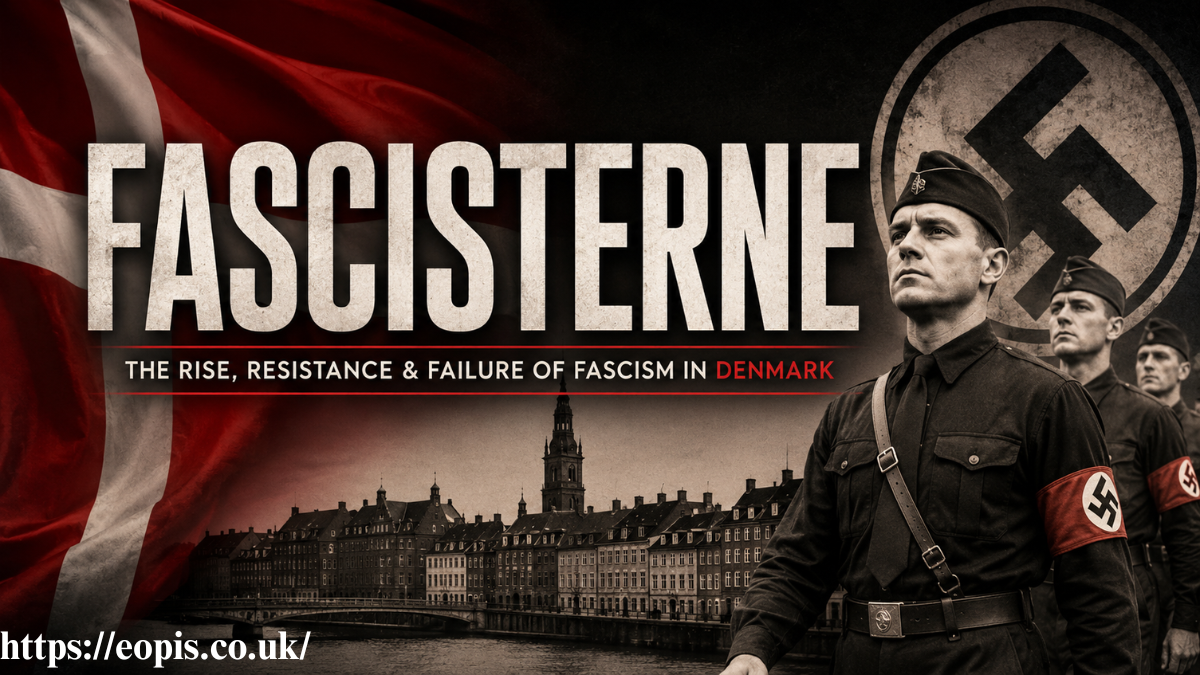
What happens when extremist ideology takes root in one of the world’s most democratic nations? The story of Fascisterne — the Danish word for “the fascists” — offers one of history’s most instructive answers. Denmark, a small Nordic country known for its civic tolerance and strong institutions, was not immune to the wave of fascism that swept Europe in the early 20th century. From homegrown far-right parties in the 1930s to the dark years of Nazi occupation from 1940 to 1945, the phenomenon of Fascisterne tested the very soul of Danish democracy.
In this article, you will learn what the term Fascisterne means linguistically and historically, how Danish fascist movements formed and operated, why they ultimately failed to seize power, and how Denmark’s resilient resistance shaped the nation’s identity for generations. Whether you are a student of history, a political science enthusiast, or simply curious about how democracies survive authoritarian threats, this comprehensive guide provides everything you need to know about Fascisterne.
What Does “Fascisterne” Mean? Origins and Linguistic Context
The Danish Word and Its Definition
<br>Fascisterne is the Danish plural definite form of “fascist,” literally translating to “the fascists” in English. In Danish grammar, the suffix “-erne” denotes a definite plural — grouping a known or contextually understood set of individuals. This linguistic specificity means the word does not refer to fascists in an abstract sense; rather, it points to specific, identifiable individuals or groups who aligned with fascist ideology.
The root word “fascism” itself derives from the Latin fasces — a bundle of rods bound around an axe, symbolizing authority, unity, and collective power in ancient Rome. This symbol was later adopted by Benito Mussolini’s movement in Italy in the early 1920s and inspired subsequent authoritarian political movements across Europe, including those that would emerge in Denmark.
How the Term Is Used in Denmark
In Danish society and academic discourse, Fascisterne is not a casual or neutral label. It carries deep moral and historical weight, shaped by the trauma of occupation and collaboration during World War II. The term is used primarily in:
- Historical education — to describe groups that collaborated with Nazi Germany or promoted authoritarian ideology
- Political commentary — as a critical descriptor for far-right or anti-democratic movements
- Cultural discourse — in literature, film, and journalism to invoke the dangers of political extremism
Understanding this linguistic nuance is essential to grasping why the word resonates so powerfully in Danish culture even today.
The Rise of Fascisterne: Historical Roots in the 1920s and 1930s
Europe’s Fertile Ground for Extremism
The emergence of Fascisterne in Denmark cannot be understood without first examining the broader European context. The aftermath of World War I left much of the continent in economic ruin, political chaos, and deep social anxiety. Unemployment soared. Traditional institutions lost credibility. Into this vacuum stepped authoritarian movements promising national renewal, strong leadership, and scapegoats for collective suffering.
Italy under Mussolini (1922) and Germany under Hitler (1933) became the templates for fascist governance. Their apparent early economic successes and nationalist confidence attracted admirers across Europe, including in Scandinavia.
The Formation of Danish Fascist Groups
In Denmark, the 1920s and 1930s saw the formation of several far-right organizations inspired by events abroad. The economic pressures of the Great Depression intensified social tensions and gave nationalist and anti-communist rhetoric greater appeal among disaffected citizens.
The most significant of these groups was the National Socialist Workers’ Party of Denmark — known by its Danish acronym, DNSAP (Danmarks Nationalsocialistiske Arbejderparti). Founded on 16 November 1930, the DNSAP was directly inspired by the electoral success of the Nazi Party in the German Reichstag elections of that same year.
Key characteristics of the DNSAP included:
- Mimicry of Nazi Germany: The party adopted the swastika, the Hitler salute, the Sturmabteilung (SA) paramilitary structure, and even translated the Horst Wessel Song into Danish
- Antisemitism: Though not as virulent as German Nazism, the party espoused racial theories targeting Jews and other minorities
- Extreme Danish nationalism: Unlike German Nazis, the DNSAP actually sought to reclaim the Schleswig region from Germany, arguing that ethnic Germans in the area were “Germanized Danes” who could be restored to Danish identity
- Anti-communism: Strong opposition to socialist and Marxist ideologies was central to the party’s platform
The DNSAP was initially led by Cay Lembcke but gained more prominence under Frits Clausen, who took over in 1933 and concentrated the party’s activities in North Schleswig, where support was most concentrated.
Electoral Performance and Political Limits
Despite its ambitions, the DNSAP remained a marginal political force throughout the 1930s. At the 1939 elections, with approximately 5,000 members, the party won only three seats in the Folketing (the Danish parliament), corresponding to just 1.8% of the popular vote. This modest performance reflected Danish society’s overwhelming preference for democratic values over authoritarian alternatives.
It is also worth noting that the DNSAP was not the only fascist organization in Denmark. Smaller far-right groups also operated during this period, collectively constituting what historians refer to as the broader Fascisterne movement.
Fascisterne During the Nazi Occupation of Denmark (1940–1945)
Germany’s Invasion and the Danish Response
On 9 April 1940, Nazi Germany invaded and occupied Denmark — a pivotal moment that would define the country’s relationship with Fascisterne for decades. Unlike some occupied nations, Denmark’s government initially chose a policy of negotiated co-operation with German authorities, allowing Danish institutions to function under tight constraints in exchange for a degree of internal autonomy.
The DNSAP enthusiastically supported the invasion and hoped that German occupation would finally propel the party into political power. However, German administrators, including Reich Plenipotentiary Cecil von Renthe-Fink, ultimately decided against installing a Nazi government in Denmark. A key reason for this was the failure of the DNSAP’s rally on 17 November 1940 — planned as a show of force to signal the party’s readiness to take power. Instead, the rally was confronted by a massive, hostile crowd that vastly outnumbered the participants. Danish police had to escort DNSAP members to safety to protect them from angry bystanders — a powerful demonstration of popular rejection.
The Role of Danish Fascists Under Occupation
Though denied formal political power, Fascisterne played several roles during the occupation:
- Collaboration: Some members actively collaborated with German occupiers, providing intelligence and facilitating operations
- Waffen-SS Recruitment: One of the DNSAP’s most significant wartime activities was organizing recruitment for the Waffen-SS and Frikorps Danmark (Free Corps Denmark). Approximately 6,000 Danes voluntarily enlisted in the Waffen-SS during the war — a sobering figure that illustrates the reach of fascist ideology even in a democracy
- Propaganda: The party’s newspaper, Fædrelandet (“The Fatherland”), served as a vehicle for pro-Nazi messaging
The Danish Resistance
Set against the backdrop of collaboration, Denmark’s resistance movement stands as one of the most celebrated chapters in the country’s history. Ordinary Danes — fishermen, clergy, students, doctors — organized to protect Jewish citizens and undermine German operations. Most remarkably, in October 1943, when the Nazis ordered the deportation of Danish Jews, Danes mobilized a remarkable rescue operation that ferried approximately 7,000 Jewish citizens to safety in neutral Sweden by boat. This act of collective courage remains a defining symbol of Denmark’s rejection of fascism and its values.
By 1943, as German fortunes in the war declined, the Danish government ended its cooperation policy and the resistance intensified. The DNSAP, now deeply discredited, held its last elections in 1943, managing only 2.1% of the vote despite five years of German occupation. The party was formally banned on 8 May 1945 — the day of liberation.
What Did Fascisterne Actually Believe?
Understanding the ideological foundations of Fascisterne is crucial for recognizing similar patterns in contemporary politics. Political historians identify several core pillars:
1. Ultra-Nationalism
Fascisterne placed the nation above all else. Danish fascists emphasized the preservation of Danish cultural identity, ethnic heritage, and linguistic unity — often in exclusionary terms that marginalized minorities and immigrants.
2. Authoritarianism
Democratic processes were viewed as weak and inefficient. Fascisterne favored strong, centralized leadership with a single dominant figure capable of making decisive, unilateral decisions. This directly contradicted Denmark’s long tradition of parliamentary democracy and consensus-based governance.
3. Anti-Communism
Fear of Soviet-style communism was a central organizing principle. Fascisterne positioned itself as the shield against the perceived communist threat — a framing that attracted support from certain conservative and business circles who feared socialist redistribution.
4. Militarism
The glorification of military strength, national sacrifice, and war as a purifying force was a hallmark of fascist ideology. Fascisterne admired the martial culture of Nazi Germany and sought to cultivate similar values in Danish society.
5. Suppression of Opposition
Free press, political pluralism, and civil liberties were treated as obstacles to national unity. Propaganda, censorship, and intimidation were tools embraced by fascist movements to silence critics and consolidate power.
Why Fascisterne Failed in Denmark: The Power of Democratic Resilience
One of the most instructive aspects of Denmark’s encounter with Fascisterne is not that it happened, but that it failed. Several factors explain the Danish resistance to fascism:
Strong Democratic Institutions
Denmark had a long-established parliamentary tradition, an independent judiciary, and a civic culture that valued pluralism and open debate. These institutions created structural barriers to authoritarian takeover.
Civic Solidarity
Danish society demonstrated remarkable cohesion in the face of occupation. The willingness of ordinary citizens to protect Jewish neighbors, shelter resistance fighters, and defy Nazi orders reflected deep-rooted communal values that fascism could not displace.
Economic and Social Safety Nets
Denmark’s Social Democratic governments of the 1930s had implemented welfare policies that cushioned citizens against the worst effects of the Great Depression — reducing the economic desperation that fascism elsewhere exploited.
Public Rejection of Fascist Spectacle
The humiliating failure of the November 1940 DNSAP rally — where party members had to be rescued by police from an outraged public — demonstrated vividly that Danish society would not passively accept fascist street politics.
The Modern Relevance of Fascisterne: Lessons for Today
How Denmark Teaches This History
Today, the story of Fascisterne is a core part of Danish school curricula. Students learn about World War II, the Holocaust, the German occupation, and the Danish resistance — not merely as historical events, but as living lessons in why democracy requires active defense. Museums, memorial sites, and cultural institutions reinforce these lessons outside the classroom.
Warning Signs of Resurgent Extremism
Scholars and educators use the history of Fascisterne to identify warning signs of authoritarian creep in modern democracies:
- Attacks on press freedom and the labeling of independent media as enemies
- Scapegoating of minority groups as the cause of national problems
- Erosion of judicial independence and democratic norms
- Glorification of violence and militarism in political rhetoric
- Personality cults built around charismatic leaders who claim to speak for “the people”
The Term’s Use in Contemporary Politics
In modern Danish and European political discourse, the term Fascisterne is sometimes applied — controversially — to contemporary far-right movements. Scholars caution that precision matters: not every nationalist or populist movement is fascist, and overuse of the label can dilute its historical meaning and moral seriousness. At the same time, willful blindness to genuine authoritarian trends serves no one.
Conclusion
The history of Fascisterne is more than a story about Denmark’s darkest political chapter — it is a testament to the fragility and the resilience of democracy. From the founding of the DNSAP in 1930 to the liberation of Denmark in 1945, the fascist movement in Denmark was ultimately defeated not by military force alone, but by the determined civic resistance of ordinary people who refused to surrender their values.
The word Fascisterne endures in the Danish language as a warning — a reminder that authoritarian ideologies can emerge in any society under the right conditions, and that democracy must be actively defended, generation after generation. As students, citizens, and engaged members of democratic societies, the most powerful thing we can do is learn this history honestly, teach it faithfully, and remain vigilant against the conditions that allowed Fascisterne to rise in the first place.
Stay informed. Protect democratic institutions. Remember history.
You May Also Like 515 Area Code
Frequently Asked Questions (FAQs)
Q1: What does “Fascisterne” literally mean in English?
Fascisterne is the Danish plural definite form of “fascist,” translating directly to “the fascists” in English. The suffix -erne makes the noun both plural and definite in Danish, indicating specific, identifiable individuals or groups rather than an abstract category.
Q2: Was Denmark a fascist country during World War II?
No. Denmark was occupied by Nazi Germany from April 9, 1940, to May 5, 1945, but the country never became a fascist state. The Danish government maintained a degree of autonomy through a policy of negotiated cooperation, and the main Danish fascist party — the DNSAP — was never included in the wartime government. Danish civil society actively resisted fascism throughout the occupation.
Q3: How large was the DNSAP, Denmark’s main fascist party?
At its peak in 1943, the DNSAP had approximately 19,000 members. However, it never achieved significant electoral success, reaching only about 2.1% of the popular vote even during the years of German occupation. Its political influence remained marginal throughout its existence, and it was banned on liberation day in 1945.
Q4: How did Denmark protect its Jewish population during the Nazi occupation?
In October 1943, when Nazi Germany ordered the deportation of Danish Jews, ordinary Danes organized a remarkable rescue operation. Fishermen, neighbors, and community members helped ferry approximately 7,000 Jewish citizens across the sea to neutral Sweden, saving the vast majority of Denmark’s Jewish population from the Holocaust. This rescue is considered one of the most heroic acts of collective resistance in World War II history.
Q5: Is fascism still a relevant concern in Denmark today?
While Denmark is a stable, well-functioning democracy, historians and political scientists note that the conditions which gave rise to Fascisterne — economic anxiety, social fragmentation, and political polarization — can reappear in any society. Denmark addresses this through robust civic education, open public discourse, and strong democratic institutions. The legacy of Fascisterne is actively taught in schools precisely to ensure that future generations can recognize and resist authoritarian ideologies before they take hold.