Have you ever sat in the dentist’s chair and heard phrases like “we need to look at tooth 19” or “number 14 has a cavity” — and had absolutely no idea what they were talking about? You’re not alone. Most patients struggle to decode the language their dental team uses, and it’s mostly because teeth are identified not just by name, but by number.
Understanding teeth numbers isn’t just trivia — it empowers you to follow along with your treatment plan, ask the right questions, and take ownership of your oral health. This complete guide breaks down every numbering system used in dentistry, explains each tooth’s name and function, covers baby teeth, and shows you exactly how to read your own dental chart.
What Are Teeth Numbers?
Teeth numbers are a standardized labeling system that allows dental professionals around the world to identify each tooth precisely and communicate without ambiguity. Whether a dentist is writing up a treatment plan, filing an insurance claim, referring a patient to a specialist, or simply talking to a hygienist across the room, teeth numbers serve as a universal shorthand.
Without a numbering system, describing teeth would quickly become messy. Saying “the second large tooth on the upper left” leaves too much room for error. Saying “tooth 14” does not.
There are three major systems in use today:
- The Universal Numbering System — used in the United States
- The FDI World Dental Federation Notation (ISO 3950) — used internationally
- The Palmer Notation System — popular in the UK and among orthodontists
Each system has its own logic, but all three exist for the same reason: accuracy in dental care.
The Universal Numbering System (U.S. Standard)
The Universal Numbering System was officially adopted by the American Dental Association (ADA) in 1968 and remains the dominant system used in the United States today. It assigns each of the 32 permanent adult teeth a unique number from 1 to 32.
How the Numbering Works
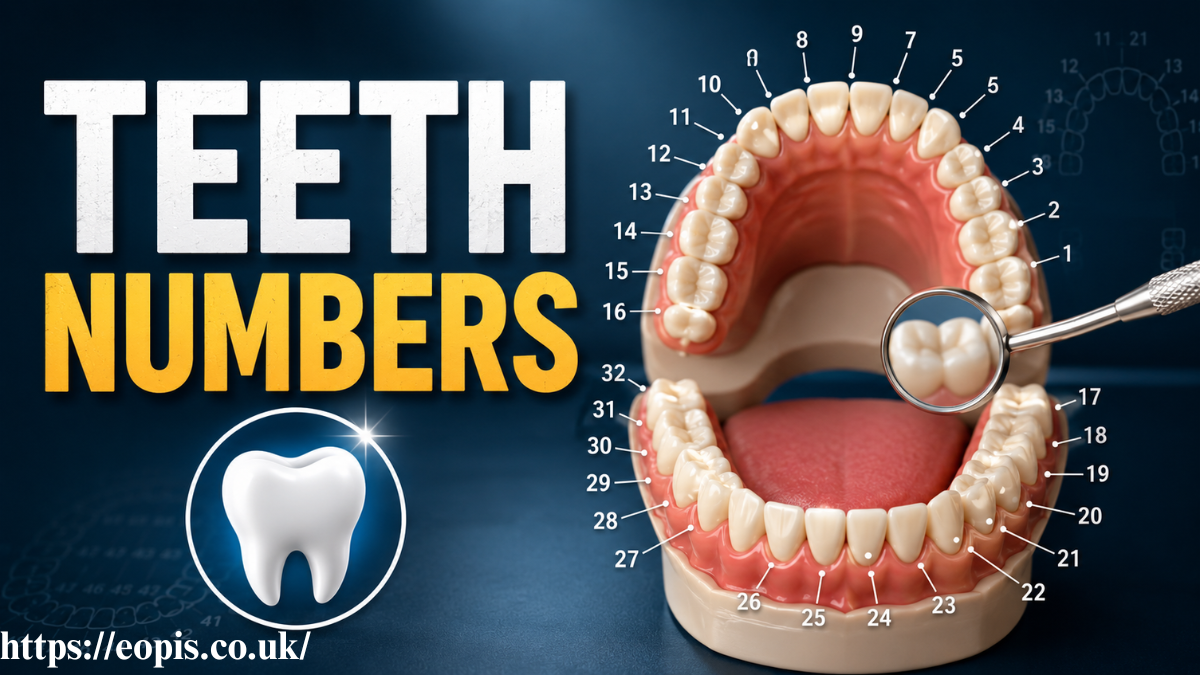
The count begins at the upper right third molar (your wisdom tooth on the upper right), designated as tooth #1. From there, the numbers move across the upper arch from right to left — so tooth #16 is the wisdom tooth at the upper left. The count then drops down to the lower jaw, starting at #17 (the lower left wisdom tooth), and continues right across the bottom arch, ending at #32 (the lower right wisdom tooth).
Think of it as a large U-shape: across the top from right to left, then across the bottom from left to right.
Quadrant Breakdown
To quickly locate a tooth by number, it helps to think in quadrants:
| Quadrant | Teeth Numbers | Location |
| Upper Right | 1 – 8 | Top right of your mouth |
| Upper Left | 9 – 16 | Top left of your mouth |
| Lower Left | 17 – 24 | Bottom left of your mouth |
| Lower Right | 25 – 32 | Bottom right of your mouth |
All 32 Adult Teeth: Numbers, Names, and Functions
Adults have four types of teeth, each serving a distinct purpose. Here’s a complete breakdown of every tooth by number, along with its name and role.
Incisors (Teeth #7–10 and #23–26)
Incisors are the eight flat, sharp front teeth — four on top and four on the bottom. They are designed for cutting food cleanly and are the most visible teeth when you smile. The upper central incisors are #8 and #9, and the lower central incisors are #24 and #25. Lateral incisors sit just beside them: #7 and #10 on top, #23 and #26 on the bottom.
Canines (Teeth #6, #11, #22, and #27)
Also called cuspids or eyeteeth, canines are the pointed teeth adjacent to the incisors. There are four canines total — one in each quadrant. They are the longest teeth in the mouth and are built for tearing and ripping food. In the Universal System, they fall at #6 (upper right), #11 (upper left), #22 (lower left), and #27 (lower right).
Premolars / Bicuspids (Teeth #4, #5, #12, #13, #20, #21, #28, and #29)
Premolars sit between the canines and the molars. Adults have eight of them — two in each quadrant. They have a broad, ridged surface that makes them ideal for crushing and grinding food. Unlike molars, premolars do not appear in children’s primary (baby) teeth; they only exist in the permanent adult dentition.
Molars (Teeth #1–3, #14–19, and #30–32)
Molars are the largest, most powerful teeth in the mouth. There are 12 in a full set (including wisdom teeth), and they are responsible for thoroughly grinding food before swallowing. The first molars — #3, #14, #19, and #30 — are the primary chewing teeth and among the most commonly treated teeth in adults. First molars are particularly significant: they are usually the first permanent teeth to erupt in children, and because they arrive so early (around age 6), they are especially vulnerable to decay.
Wisdom Teeth (Teeth #1, #16, #17, and #32)
Wisdom teeth are the third molars, appearing at the very back of the mouth. In the Universal System, they are teeth #1, #16, #17, and #32. Many people have some or all of their wisdom teeth removed due to impaction, crowding, or lack of space in the jaw.
Complete Teeth Number Reference Table
| Tooth # | Name | Location |
| 1 | Upper Right Third Molar (Wisdom Tooth) | Upper Right |
| 2 | Upper Right Second Molar | Upper Right |
| 3 | Upper Right First Molar | Upper Right |
| 4 | Upper Right Second Premolar | Upper Right |
| 5 | Upper Right First Premolar | Upper Right |
| 6 | Upper Right Canine | Upper Right |
| 7 | Upper Right Lateral Incisor | Upper Right |
| 8 | Upper Right Central Incisor | Upper Right |
| 9 | Upper Left Central Incisor | Upper Left |
| 10 | Upper Left Lateral Incisor | Upper Left |
| 11 | Upper Left Canine | Upper Left |
| 12 | Upper Left First Premolar | Upper Left |
| 13 | Upper Left Second Premolar | Upper Left |
| 14 | Upper Left First Molar | Upper Left |
| 15 | Upper Left Second Molar | Upper Left |
| 16 | Upper Left Third Molar (Wisdom Tooth) | Upper Left |
| 17 | Lower Left Third Molar (Wisdom Tooth) | Lower Left |
| 18 | Lower Left Second Molar | Lower Left |
| 19 | Lower Left First Molar | Lower Left |
| 20 | Lower Left Second Premolar | Lower Left |
| 21 | Lower Left First Premolar | Lower Left |
| 22 | Lower Left Canine | Lower Left |
| 23 | Lower Left Lateral Incisor | Lower Left |
| 24 | Lower Left Central Incisor | Lower Left |
| 25 | Lower Right Central Incisor | Lower Right |
| 26 | Lower Right Lateral Incisor | Lower Right |
| 27 | Lower Right Canine | Lower Right |
| 28 | Lower Right First Premolar | Lower Right |
| 29 | Lower Right Second Premolar | Lower Right |
| 30 | Lower Right First Molar | Lower Right |
| 31 | Lower Right Second Molar | Lower Right |
| 32 | Lower Right Third Molar (Wisdom Tooth) | Lower Right |
Baby Teeth Numbers: The Primary Dentition System
Children have 20 primary teeth — also known as baby teeth, milk teeth, or deciduous teeth. They typically begin erupting around 6 months of age and fall out between ages 6 and 12, giving way to permanent adult teeth.
In the Universal Numbering System, baby teeth are not numbered like adult teeth. Instead, letters A through T are used to distinguish them clearly and prevent any confusion with permanent teeth in dental records.
The lettering follows the same path as adult numbering: it begins at the upper right second primary molar (A), moves across the upper arch to the upper left second primary molar (J), then drops to the lower left second primary molar (K), and continues across to the lower right second primary molar (T).
Baby Teeth Letter Reference
| Letter | Tooth Name |
| A | Upper Right Second Primary Molar |
| B | Upper Right First Primary Molar |
| C | Upper Right Primary Canine |
| D | Upper Right Lateral Incisor |
| E | Upper Right Central Incisor |
| F | Upper Left Central Incisor |
| G | Upper Left Lateral Incisor |
| H | Upper Left Primary Canine |
| I | Upper Left First Primary Molar |
| J | Upper Left Second Primary Molar |
| K | Lower Left Second Primary Molar |
| L | Lower Left First Primary Molar |
| M | Lower Left Primary Canine |
| N | Lower Left Lateral Incisor |
| O | Lower Left Central Incisor |
| P | Lower Right Central Incisor |
| Q | Lower Right Lateral Incisor |
| R | Lower Right Primary Canine |
| S | Lower Right First Primary Molar |
| T | Lower Right Second Primary Molar |
Because children don’t have premolars and their third molars (wisdom teeth) haven’t yet developed, each quadrant has only five primary teeth, giving 20 total.
Primary teeth play a critical role even before permanent teeth arrive. They help children chew properly, support speech development, and, crucially, they act as placeholders that guide permanent teeth into their correct positions as they erupt.
The FDI World Dental Federation Notation
Used widely across Europe, Asia, Canada, and much of the rest of the world, the FDI system (also known as ISO 3950) takes a different approach: each tooth receives a two-digit code. The first digit identifies the quadrant, and the second identifies the tooth’s position within that quadrant.
FDI Quadrant Numbering for Adult Teeth
| Digit | Quadrant |
| 1 | Upper Right |
| 2 | Upper Left |
| 3 | Lower Left |
| 4 | Lower Right |
The second digit runs from 1 (central incisor) to 8 (third molar), counting outward from the midline. So tooth 11 (pronounced “one-one”) is the upper right central incisor; tooth 36 is the lower left first molar; and tooth 48 is the lower right wisdom tooth.
For primary (baby) teeth, the quadrant numbers shift to 5, 6, 7, and 8 (for upper right, upper left, lower left, and lower right, respectively), and the second digit runs from 1 to 5, since children have only five teeth per quadrant.
Why Two Systems Exist
The Universal System is intuitive for sequential documentation and is deeply embedded in American dental practice, insurance forms, and electronic health records. The FDI system, by contrast, provides a logical two-digit code that is easier to adapt for international data exchange and computerized charting, which is why the World Health Organization officially endorses it.
The Palmer Notation System
The Palmer Notation System, popular in the United Kingdom and among orthodontists worldwide, uses a grid of quadrant symbols combined with numbers or letters. Each quadrant of the mouth is assigned a bracket symbol:
- ┘ = Upper Right
- └ = Upper Left
- ┐ = Lower Right
- ┌ = Lower Left
For permanent teeth, the numbers 1 through 8 are used within each quadrant, starting at the central incisor (1) and moving outward to the wisdom tooth (8). For primary teeth, the letters A through E replace the numbers. So the upper right first molar is written as 6┘, and the lower left baby canine is ┌C.
The Palmer system was favored by the ADA as early as 1947, but because its symbols were difficult to type on keyboards, it was eventually replaced by the Universal System for most administrative purposes in the U.S. It remains widely used in clinical settings, particularly in orthodontics, where the visual grid maps directly onto the patient’s dental arch.
How to Read Your Own Dental Chart
Your dental chart is the document your dentist maintains to record the condition of every tooth. When you look at it, here’s what you’ll typically find:
Tooth numbers or letters — identifying each specific tooth by the system your dental office uses (most commonly Universal in the U.S.).
Condition notes — symbols and abbreviations indicating the current state of each tooth. Common abbreviations include:
- RCT — Root Canal Treatment (has been or needs to be performed)
- DO — Distal-Occlusal filling (a filling on specific surfaces of the tooth)
- X — Extraction (tooth has been removed)
- C — Crown in place
Color coding — many charts use red to indicate existing work and blue or black to indicate new or planned treatment.
When your dentist says a tooth “needs a filling,” ask for the number. When they discuss an extraction, confirm the number on the chart. Knowing the number lets you look it up, understand its function, and make more informed decisions about your care.
Most Commonly Referenced Teeth Numbers (and Why They Matter)
Some tooth numbers come up more often than others in dental visits. Here’s a quick reference for the ones most relevant to patients:
Tooth #1, #16, #17, #32 — Wisdom Teeth. These are the most commonly extracted teeth in adults. Many people don’t have enough jaw space for all four, leading to impaction, crowding, or infection.
Tooth #3, #14, #19, #30 — First Molars. These are the primary chewing teeth and often the first permanent teeth to need fillings or crowns. Tooth 30 (the lower right first molar) is one of the most frequently treated teeth in adult dentistry.
Teeth #6–11 (upper) and #22–27 (lower) — The Cosmetic Zone. If you’re considering veneers, bonding, or whitening, these are the teeth most visible when you smile. They are the focus of most cosmetic dentistry procedures.
Teeth #8 and #9 — Upper Central Incisors. The two most prominent front teeth. Chipped, cracked, or discolored central incisors are among the most common reasons people seek cosmetic dental treatment.
Tooth #19 — Lower Left First Molar. Frequently cited in treatment discussions, this large molar is a common site for decay, root canals, and crown placement.
Teeth Numbers and the Dental Numbering System: A Brief History
The concept of systematically numbering teeth dates back to 1881, when German dentist Julius Parreidt first proposed a universal dental notation. The Palmer notation followed, gaining recognition by the ADA in 1947. However, the symbols required for Palmer notation were difficult to reproduce on standard typewriters and later keyboards, which led the ADA to officially adopt the Universal Numbering System in 1968.
The FDI system was developed as a globally compatible alternative and has since been endorsed by both the World Health Organization and the Fédération Dentaire Internationale — making it the default system for international dental research and record exchange today.
Why Teeth Numbers Matter for Patients (Not Just Dentists)
It’s tempting to think tooth numbers are purely a dentist’s tool, but understanding them offers real benefits to patients:
Better communication. When you know that tooth #14 is your upper left first molar, you can describe sensitivity or pain precisely — saving time and reducing the chance of misdiagnosis.
Informed consent. Before agreeing to a procedure, you can confirm exactly which tooth is being treated. Dental errors, while rare, do occur, and knowing your tooth numbers is a simple safeguard.
Clearer treatment plans. A treatment plan that says “filling on #19, crown on #30, and extraction of #32” is far easier to follow and budget for when you can picture exactly which teeth are involved.
Insurance and billing. Insurance claims use tooth numbers to document and verify procedures. Knowing your numbers helps you cross-check your Explanation of Benefits and catch billing errors.
Orthodontic tracking. If you’re undergoing braces or aligner treatment, your orthodontist will use tooth numbers to track movement and document progress at every appointment.
Teeth Numbers Quick Reference: Key Facts
- Adults have 32 permanent teeth, numbered 1 to 32 in the Universal System.
- Children have 20 primary teeth, labeled A to T in the Universal System.
- Wisdom teeth are numbers 1, 16, 17, and 32.
- Upper central incisors (the two most prominent front teeth) are numbers 8 and 9.
- Canines are numbers 6, 11, 22, and 27.
- Teeth 1–8 are in the upper right quadrant.
- Teeth 9–16 are in the upper left quadrant.
- Teeth 17–24 are in the lower left quadrant.
- Teeth 25–32 are in the lower right quadrant.
- The FDI system uses two-digit codes; the first digit is the quadrant (1–4 for adults), and the second is the tooth position (1–8).
- The Palmer system uses bracket symbols plus numbers 1–8 per quadrant.
- The Universal System was officially adopted by the ADA in 1968.
- Supernumerary (extra) teeth in the Universal System are designated numbers 51–82.
Frequently Asked Questions About Teeth Numbers
What tooth number is a wisdom tooth? In the Universal Numbering System, the four wisdom teeth are numbers 1, 16, 17, and 32. These are the third molars, located at the very back of each quadrant of the mouth.
What is tooth #14? Tooth #14 is the upper left first molar — one of the main chewing teeth on the top left side of your mouth.
What is tooth #19? Tooth #19 is the lower left first molar. It is one of the most frequently treated teeth in adult dentistry and is a common site for fillings, crowns, and root canals.
What is tooth #30? Tooth #30 is the lower right first molar — the large chewing tooth at the back right of your lower jaw. It is one of the most commonly treated teeth in adult patients.
How are baby teeth numbered? In the Universal System, baby teeth are not numbered — they use letters A through T. Letter A is the upper right second primary molar, and the letters continue across the upper arch and then the lower arch, ending with T at the lower right second primary molar.
What numbering system does my dentist use? In the United States, most dentists use the Universal Numbering System. Ask your dental office to confirm which system they use, especially if you are traveling internationally or seeing a specialist.
Do all countries use the same tooth numbering system? No. The United States primarily uses the Universal Numbering System. Most of the rest of the world — including Europe, Canada, and many countries in Asia — uses the FDI system. The Palmer notation is common in the United Kingdom and is popular among orthodontists globally.
Conclusion
Teeth numbers are far more than a technical detail left to dental professionals. They are the backbone of accurate dental communication, precise treatment planning, and informed patient care. Whether you’re tracking a cavity, preparing for wisdom tooth surgery, discussing cosmetic options, or simply trying to understand your dental bill, knowing how to read a tooth number chart puts you firmly in control of your own oral health.
You May Also Like TruVirility